

How to Make a Small Room Feel Larger: 15 Decorating Tricks That Work

Inside: Real-life decorating ideas for making a small room feel larger through paint, furniture placement, lighting, and layout changes that add up to more breathing room.

This post contains Amazon and other affiliate links for your convenience. As an Amazon Associate I earn from qualifying purchases. If you purchase something through any link, I may receive a small commission, at no extra charge to you. I only recommend products that I love or would purchase for myself. See my full disclosure here.
Let’s talk about that small room that should feel fine… but doesn’t.
It’s clean. You’ve decorated it. But somehow, it doesn’t feel like you’ve done either.
Every time you sit down in there, something feels off. A little crowded. A little “why do I not like this more?” Maybe even a little chaotic in a way you can’t quite put your finger on.
What I’ve learned after downsizing is that making a small room feel right usually comes down to how things are arranged and what’s left out.
How Do You Make a Small Room Feel Larger?
Short answer? You stop fighting the room and start working with what it gives you.
Letting in light, keeping colors calm, choosing furniture that actually fits, and editing back the extra stuff all play a role. The rest of this post breaks those ideas down into specific, doable fixes you can actually use in your own small space.
15 Decorating Tricks That Make a Small Room Feel Larger.
1. Use light, consistent paint colors.
Small rooms don’t love a lot of drama on the walls. High contrast and bold color changes tend to make the space feel chopped up and smaller than it already is.
I’ve found that lighter, calmer paint colors that flow help everything feel more connected. And no, it’s not boring. Just easier on the eyes.

2. Keep flooring consistent when possible.
In a small space sightlines are shorter, so changes stand out. When flooring changes from room to room, or even within the same view, it creates visual stops that make the space feel more broken up and smaller than it really is.

In my home, all of the open areas you can see from one another—the entry, dining area, kitchen, and family room all share the same flooring. That continuity makes everything feel larger and more connected, even though each space serves a different purpose. The rooms flow together instead of visually stopping the view at every threshold.
If consistent flooring isn’t possible, minimizing the contrast between surfaces can still help. The goal is to keep the visual flow moving instead of constantly interrupting it.
3. Let in as much natural light as possible.
Natural light does more than brighten a room. It reduces harsh shadows from artificial lighting and makes surfaces feel less stark, which matters even more in smaller rooms.
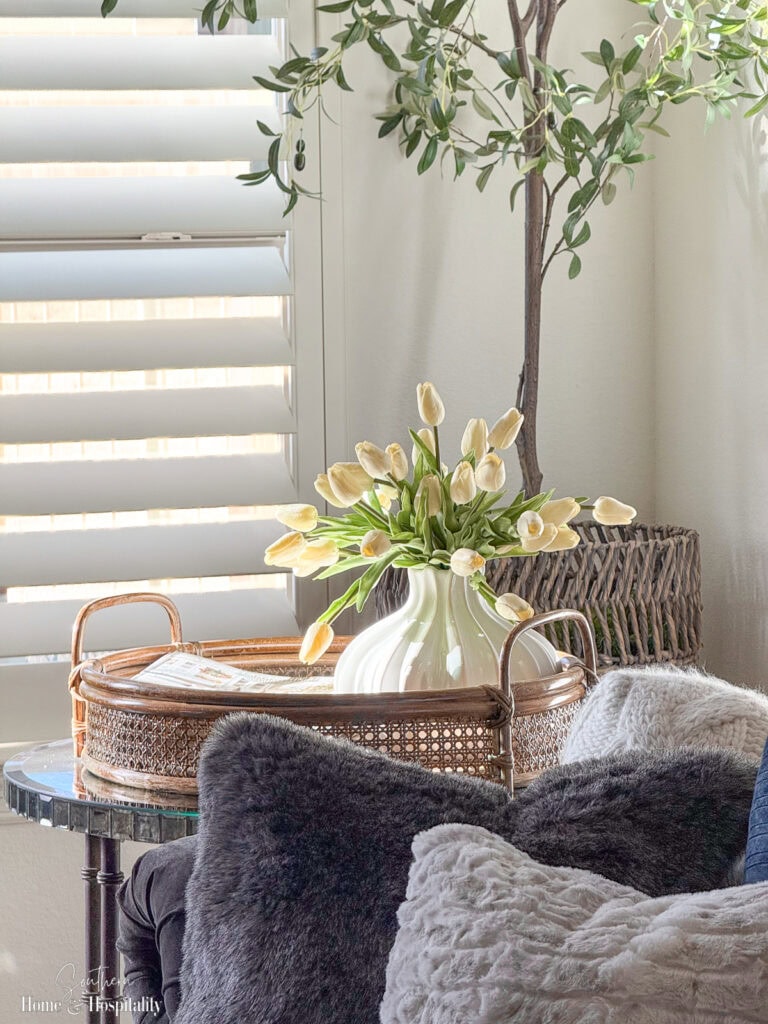
I’ve become much more aware of where light comes into a room or anything that might be blocking it, like bulky furniture or heavy decor in front of windows, or even window treatments that cover the sides. When light can move freely, the whole space feels larger and less crowded.
4. Use mirrors to reflect light, not just fill space.
Mirrors work especially well in small rooms when they’re doing more than just filling a blank wall. If they’re reflecting light or a window, they’re actually helping the space feel more open.
If a mirror is reflecting something bright, it’s earning its spot.

5. Don’t automatically push everything against the wall.
I know it feels safer to shove furniture against the walls, but that can actually make a room feel flatter and more boxed in.
Pulling a sofa or chair out just a little can add depth and make the layout feel more cohesive. It doesn’t work everywhere, but when it does, it’s kind of magic.

6. Keep window treatments simple.
Window treatments can work in a small room, but they need to stay visually light. Simpler styles and lighter fabrics help windows feel like an opening instead of a focal point.
Heavy, layered styles tend to overwhelm the space, especially when they cover a lot of the window or spill onto the surrounding wall.

In my home, I don’t currently have drapes—I chose plantation shutters because they keep the window area clean while still letting in light.
7. Hang window treatments higher than the window.
Hanging curtain rods higher than the window helps draw the eye upward, which makes the ceiling feel taller and the room feel less compressed. It also helps to keep the sides of the window as open as possible so natural light isn’t blocked.
Even without drapes, the goal is the same—don’t let view stop at the top or sides of the window.
8. Edit back the little stuff.
Small rooms don’t leave much room for excess. Too many decorative items, especially small ones, can make a space feel busy and cramped, even if everything is pretty.

I’ve found that editing back almost always makes a room feel calmer and more open—even when I’m convinced I still “need” everything that’s there.
9. Use fewer, bigger decor pieces.
Fewer, slightly larger pieces usually feel more “right,” especially in smaller rooms where everything shows up faster. It’s one of those cases where scale and proportion really matter.
One good lamp or piece of art often works better than five small things fighting for attention.

10. Look for furniture with legs.
Furniture that goes straight to the floor tends to feel heavier. Pieces with visible legs let you see more of the floor, which helps the room feel lighter.
It’s a small detail, but it does make a difference.

11. Choose furniture that fits the room you’re in now.
This was one of my biggest adjustments after downsizing. Some of the furniture that felt “normal” in my previous home suddenly felt oversized in a smaller one.

A good example is the console table I made over in my entry. It’s much more shallow than a typical foyer table, but that’s exactly why it works here. It gives me a place to decorate without crowding the walkway or making the space feel tight. In smaller rooms, depth matters just as much as width.
I also had to say a sad goodbye to a beautiful leather sectional I loved because it was simply too massive and the wrong configuration for the family room. Even though letting this lovely go was hard, it was absolutely the right call.
When furniture fits the scale of the room you’re in now, everything feels easier. The room relaxes. And so do you.
12. Choose furniture that earns its keep.
In a small room, every piece needs to pull its weight.

In my living room, the sofa ottomans aren’t just a place to put your feet up—they also do double duty as a coffee table. With a tray on top, they function as both pieces of furniture without adding another bulky piece to the room.
Fewer large pieces mean less visual clutter, which almost always makes a small room feel more open.
13. Emphasize height wherever you can.
In smaller rooms, drawing the eye upward helps balance the space and keeps it from feeling short or heavy. It’s something I pay much more attention to now than I ever did before.
That can mean taller lamps, vertical artwork, or anything that encourages the eye to travel up instead of stopping at furniture height. Emphasizing height helps a room feel more open and easier to be in.

14. Stick to a simple color palette.
When a room has too many unrelated colors, it can start to feel chaotic. A more cohesive palette helps everything feel calmer and more pulled together.
And calmer rooms almost always feel bigger.

15. Edit, then edit again.
This is the step I come back to most often after downsizing. Once a room is “done,” I like to live with it for a bit and see what still feels necessary.
More often than not, removing something is what finally makes the room feel right.

If you’ve tried these tips and the room still feels off, Why Your Room Doesn’t Feel Quite Right breaks down the subtle reasons that might be causing it.
Small rooms tend to teach you quickly what’s helping and what’s just taking up space. When things feel off, it’s usually not one big problem, but a few small ones adding up.
You don’t have to tackle everything at once. A slight shift in furniture, clearing a surface, or letting in more light is often enough to change how the space feels. And when a room feels calmer, it’s more simply more enjoyable to be in.
This post is the first part of my small room decorating series, where I’m sharing practical, real-life ways to make smaller spaces feel calmer, more open, and easier to live in. Instead of big renovations or starting from scratch, the focus is on the small adjustments that actually make a difference. So far in the series:
- The Best Paint Colors to Make a Small Room Feel Bigger
- How to Arrange Furniture in a Small Living Room
- 5 Mistakes That Make a Small Room Look Smaller
- How to Use Mirrors to Make a Room Look Bigger
And this post: How to Make a Small Room Feel Larger: 15 Decorating Tricks That Work

Before you go:
As always, I appreciate your visit, comments, and shares here on the blog! I’d love it if you also follow along with me on Pinterest, Instagram, Facebook, TikTok, and YouTube so you won’t miss any of my inspiration and ideas.
Don’t forget to sign up for updates to keep in touch.
If you’re not already a member of the SH&H family, I’d love to have you join me! You’ll not only get email updates, but you’ll have exclusive access to all the bonus materials in my free subscriber-only library, like this:
Pin it to remember it!
If you’ve enjoyed this post, please pin and share this on Pinterest:

Hi , Do you think one should have a 8×10 carpet in a 12x 15 room ? Would a smaller carpet work & make the room look bigger with more bare floor visible .I’m in an apartment.
Martha … marthamizzi@icloud.com
Hi Martha! A smaller carpet will work as long as it groups your furniture together like the sofa, chair(s), and coffee table.
Your Article on Decorating tips for a Small Room helped me in my constant goal of using as much Furniture, Wall Art and Decor as possible – as my wife and I used to Stage Homes and purchased items that we enjoyed; so ridding ourselves of them was a difficult process. I was pleased when I realized we practice your advice in most aspects. As we own a lot of Artwork, we do push the envelope and festoon most walls with plenty of it, and it irks me when I see a single painting above a sofa close to the ceiling. Sorry for the lengthy ramble but wanted to thank you for all your help!
Enjoyed reading your post, Kate! You have given us lots of ideas for which I thank you! We have moved to a new condo and it has been hard to downsize and let a lot of lovely furniture, etc, be given away. We are still settling in and have to part with a few more decor items which is difficult to do. Have a great week!
These are all fantastic decorating tips for smaller spaces. You are a decorating genius! 🙂
Awww Helen, thank you for that sweet uplifting comment!❤️