

The Best Paint Colors to Make a Small Room Feel Bigger

Inside: The best soft paint colors to make a small room feel more open, plus why undertones matter more than you think.

This post contains Amazon and other affiliate links for your convenience. As an Amazon Associate I earn from qualifying purchases. If you purchase something through any link, I may receive a small commission, at no extra charge to you. I only recommend products that I love or would purchase for myself. See my full disclosure here.
Sometimes there’s a difference between a small room and a room that feels small.
If a space feels cramped, we tend to blame it on the square footage. End of story.
But the color of the walls has a lot more to do with that tight feeling than most of us realize. The wrong paint shade can make the walls close in with a hard visual stop, while the right shade can somewhat soften and blur where those walls actually end.
The solution isn’t quite as simple as “light vs. dark” walls. Often times, small rooms don’t get as much natural light. And that’s where you really have to pay attention to the paint’s undertones.
So instead of just simply choosing “light colors,” it helps to understand what actually makes certain shades feel more open—and why others might work against a small room.
What Is the Best Paint Color to Make a Small Room Look Bigger?
Yes, the best paint colors for small rooms are light—soft neutrals with subtle undertones. Think creamy white, pale greige, barely-there blue-gray, and muted sage. Light, low-contrast colors soften the edges of the room instead of outlining them.
But in smaller spaces, I’ve found the softest version of a color usually works better than some of the more popular mid-tones everyone loves online. On a paint card, the best shades for small rooms can look like they’re barely a color at all. But in a tight room with average ceiling height and limited natural light, paint almost always reads darker and more saturated once it’s on the wall.
Why Undertones Matter More in Small Rooms.

It’s not just about choosing a light color. It’s about choosing one whose undertone behaves well in the kind of light the room actually gets.
In a smaller room, the walls are simply closer to you. There isn’t as much distance for color to fade into the background.
In rooms with limited natural light, warm undertones can feel stronger. A shade that looked neutral in the store can look more yellow at home. A green that felt barely there on a strip can come out much more intense on four full walls.
That doesn’t mean warm or cool tones are wrong. It just means small rooms don’t hide them the way larger spaces sometimes can.
That’s why I like to compare similar shades side by side before deciding. When you line up three versions of the same color, you can usually see which one stays light and neutral— and which might bring an unexpected color cast once it fills the room.
Soft Warm Whites (Creamy, Not Stark).
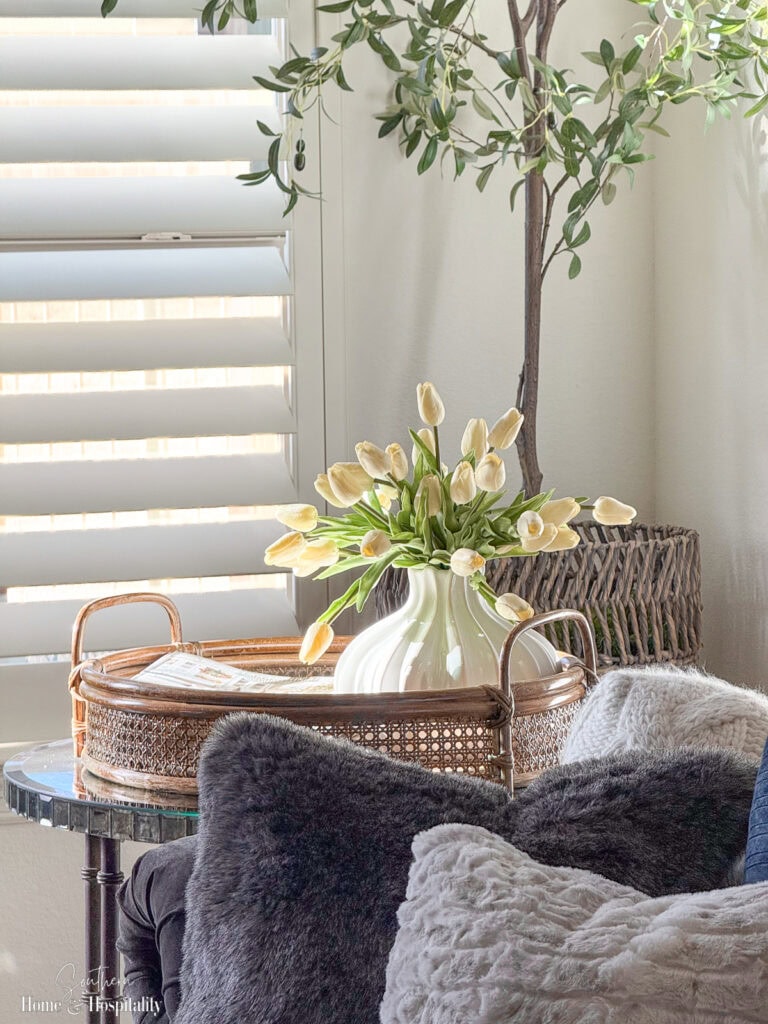
Bright, crisp whites can actually emphasize shadows in small rooms. The contrast around windows, corners, and trim becomes sharper.
A soft warm white, on the other hand, reflects light gently. It softens the edges instead of outlining them. And in smaller spaces, that subtle softness can make a noticeable difference.
Subtle Warm White Options:

Sherwin-Williams
- Alabaster – SW 7008
- Greek Villa – SW 7551
Benjamin Moore
- Swiss Coffee – OC-45
- White Dove – OC-17
These shades stay light without feeling stark or icy. Swiss Coffee has been a longtime favorite of mine—all of the trim and cabinets in my last house were painted in it.
What to Avoid:
Ultra-bright whites with strong blue undertones in rooms that don’t get much natural light. They can make shadows look harsher instead of softer.
Very Light Greige (Barely There Depth).

Greige can be beautiful in a small room—but it’s also the category that gets pushed too dark most often in tight spaces.
The popular greiges that everyone raves about tend to be mid-toned. They look lighter and more neutral in large, well-lit spaces. In smaller rooms, they can absorb more light than you expect.
If your goal is openness, the lightest version of greige usually works best. Some of these sample suggestions even have “white” in the name, but will read with more color in a small room.
Subtle Greige Options:

Sherwin-Williams
- Shoji White – SW 7042
- Drift of Mist – SW 9166
- Egret White – SW 7570
- Aesthetic White – SW 7035
Benjamin Moore
- Classic Gray – OC-23
- Seapearl – OC-19
- Pale Oak – OC-20
These are so light they almost read as “no color,” but they add just enough warmth to keep a room from feeling cold and flat.
What to Avoid:
Greiges that sit in the middle of the strip. Once the shade deepens, it stops reflecting light as easily. In small rooms, that can shift the feeling from airy to cozy fairly quickly.
Pale Blue-Gray (Soft and Receding).
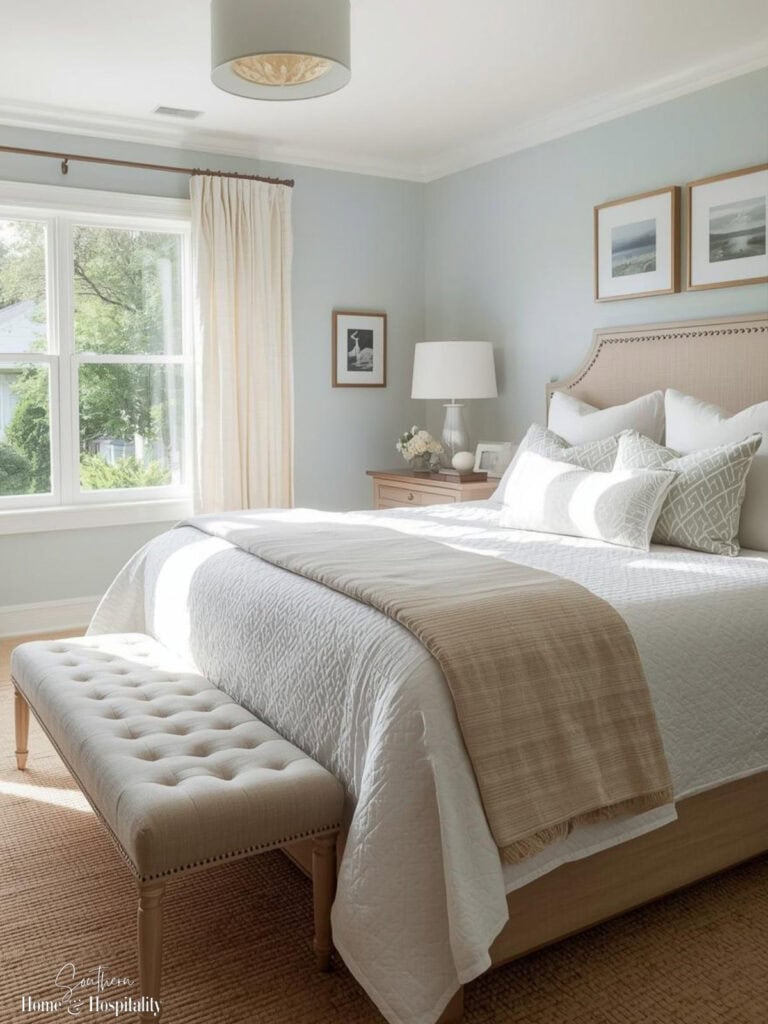
Blue-gray can be beautiful in a small room, but only when it stays in the background.
Cool tones tend to recede visually, which is helpful in tighter spaces. But that only works if the color is subtle. Once blue becomes noticeable, it shifts from “soft backdrop” to “decorative choice.” It’s easy for what looks like a shade of barely blue to become bright baby blue up on the wall.
In smaller rooms, I lean toward the palest version of a blue-gray—the kind that almost reads neutral until the light hits it.
Subtle Blue-Gray Options:
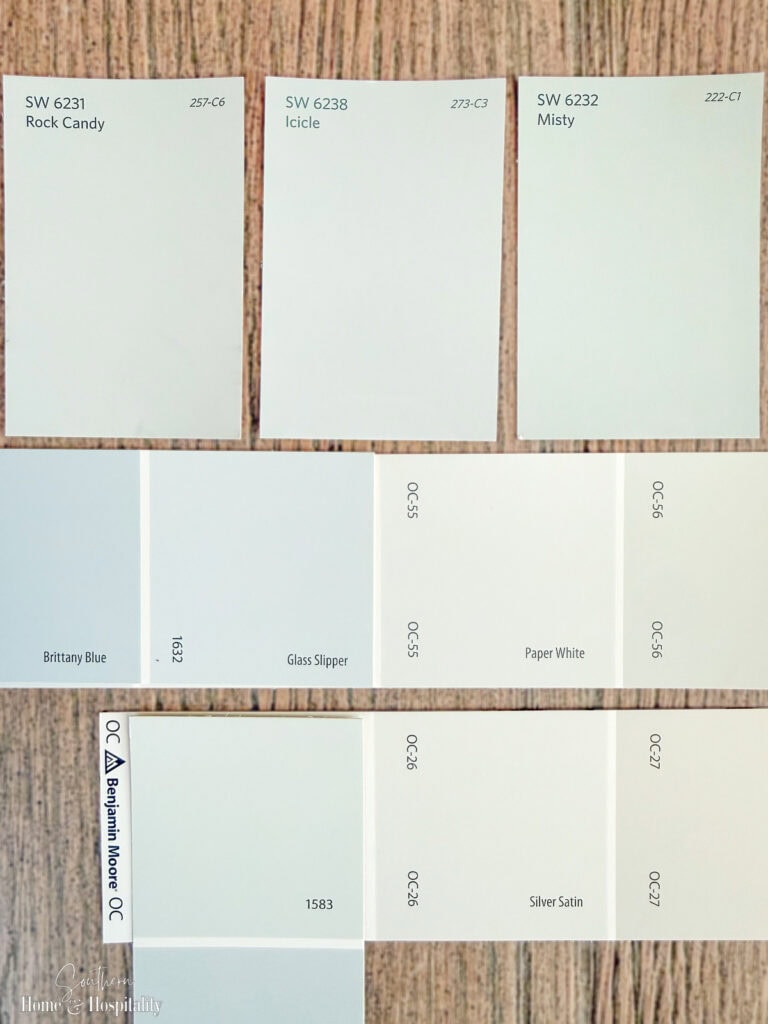
Sherwin-Williams
- Rock Candy – SW 6231
- Icicle – SW 6238
- Misty – SW 6232
Benjamin Moore
- Glass Slipper – 1632
- Paper White – OC-55
- Silver Crest – 1583
- Silver Satin – OC-26
These shades are light enough to feel airy and elegant but still add a gentle color.
What to Avoid:
Blue-grays that sit mid-strip or lean distinctly blue. In a small room, noticeable color can feel more bold than expansive, which changes the goal.
Muted Sage (Soft, Not Saturated).

Green can be incredibly calming in a small room—but like blue, it’s an easy color to overdo.
What works in a larger, light-filled space can feel stronger once it wraps around four close walls.
In tighter rooms, I’ve found that the gray-based, barely-there greens tend to feel more open than the warmer, richer versions. The goal isn’t to make the room feel colorful or warm. It’s to give it just enough color that the walls don’t feel flat.
Subtle Sage Options.
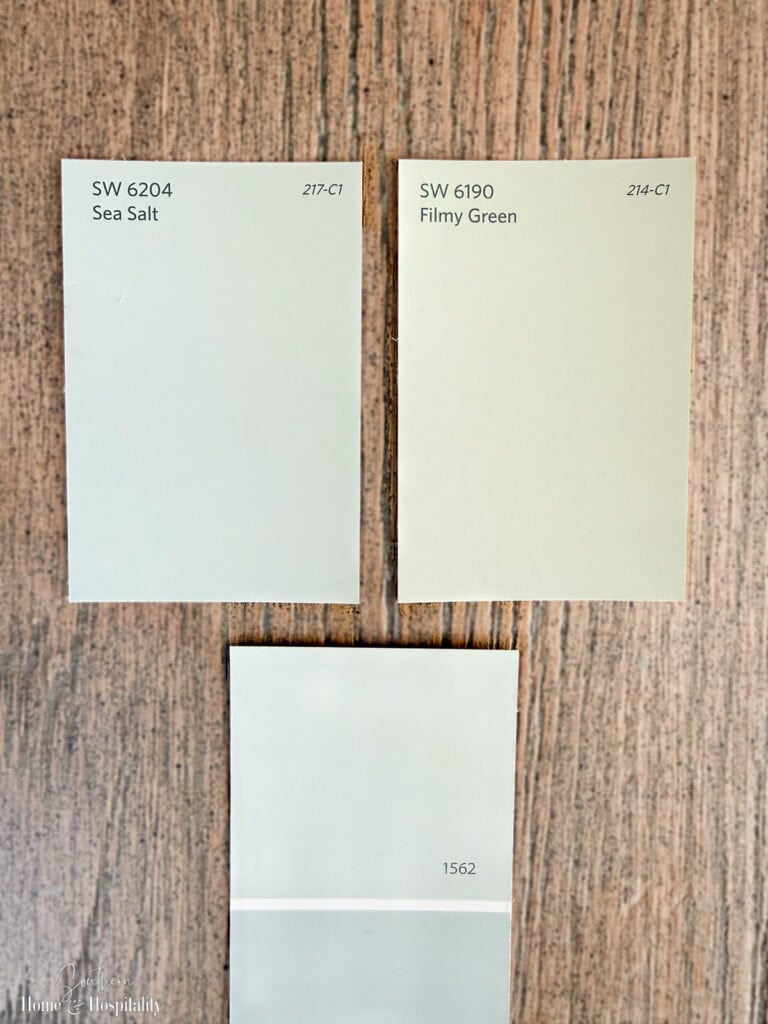
Sherwin-Williams
- Sea Salt – SW 6204
- Filmy Green – SW 6190
Benjamin Moore
- Healing Aloe – 1562
These three stay light and quiet, and bring a lovely shade of zen to a small space.
What to Avoid.
Greens that lean noticeably yellow or sit in the middle of the color strip. Once the color deepens or warms, it can change a small room from open to cozy. In small spaces, that shift is more dramatic—which is why the palest version of a sage is usually safer.
Should You Ever Go Dark in a Small Room?
You can, but that’s a different goal.
Dark paint creates coziness. Or drama. It wraps the room… and that can be lovely.
But if your aim is to make a room feel larger, lighter and softer shades will do that job better.
Trim and Ceiling Color in Small Rooms.

Trim and ceiling color don’t get talked about nearly as much as wall paint, but in a small room, they matter quite a bit.
Even the softest wall color can feel different if it’s paired with bright white or high-contrast trim. When the trim is noticeably lighter or cooler than the walls, it defines the perimeter of a small room. Lower contrast tends to soften that effect.
That doesn’t mean everything has to match perfectly. But when the trim is close in tone to the wall color (or at least not dramatically brighter), the transition feels more gentle. And gentle transitions are what help a room feel less boxed in.
Ceilings work the same way. A ceiling that’s slightly softer than stark white often blends more naturally with the walls, especially in rooms without strong overhead light. When the ceiling and walls feel cohesive instead of sharply divided, the whole space reads calmer and more continuous.
If you don’t have crown molding, or you’re working with a vaulted ceiling, the same idea still applies. The fewer hard stops your eye sees, the more open the room tends to feel. In those cases, using the same wall color on the ceiling (sometimes at a slightly lighter mix) can soften the transition even more. It keeps the eye moving instead of pausing at a sharp line.
Paint Alone Won’t Fix a Small Room.
Paint can absolutely affect how large a space feels. But it works best alongside other considerations like layout, lighting, and scale.
This post is part of my small room decorating series, where I’m sharing practical, real-life ways to make smaller spaces feel calmer, more open, and easier to live in. Instead of big renovations or starting from scratch, the focus is on the small adjustments that actually make a difference. So far in the series:
- How to Make a Small Room Feel Larger: 15 Decorating Tricks That Work
- How to Arrange Furniture in a Small Living Room
- 5 Mistakes That Make a Small Room Look Smaller
- How to Use Mirrors to Make a Room Look Bigger
And this post: The Best Paint Colors to Make a Small Room Feel Bigger
Still, color is an important piece of that puzzle.
Small rooms don’t usually need dramatic overhauls. They respond better to restraint. Like the softest version of a paint color, lower contrast, undertones that stay quiet once they’re on the wall.
Sometimes a room just needs the right shade to loosen its tie and breathe a little.

Before you go:
As always, I appreciate your visit, comments, and shares here on the blog! I’d love it if you also follow along with me on Pinterest, Instagram, Facebook, TikTok, and YouTube so you won’t miss any of my inspiration and ideas.
Don’t forget to sign up for updates to keep in touch.
If you’re not already a member of the SH&H family, I’d love to have you join me! You’ll not only get email updates, but you’ll have exclusive access to all the bonus materials in my free subscriber-only library, like this:
Pin it to remember it!
If you’ve enjoyed this post, please pin and share this on Pinterest:

This hit the nail on the head.
What is the paint color in the very first picture in the article? LOVE!!
Hi Renee! That photo is just for illustrative purposes but it’s supposed to be an example of light greige.
Kate, what color paint do you have in the photo of your family room?
Hi Nancy! My villa was already painted that color when I moved in and I’ve had to paint match because I don’t know. I’m thankful it was a good soft warm white!
I hate to ask, but what was the color match that you used? It looks like the perfect wall
paint color.
I don’t have a color name, just the paint code label on top of the can. I will say I’ve had good luck in my past home with Swiss Coffee.