

Why Your Room Doesn’t Feel Quite Right (And What’s Probably Causing It)

Inside: If your room feels off, awkward, or like it should look better than it does, here’s how to figure out what’s actually wrong, without buying something new.

This post contains Amazon and other affiliate links for your convenience. As an Amazon Associate I earn from qualifying purchases. If you purchase something through any link, I may receive a small commission, at no extra charge to you. I only recommend products that I love or would purchase for myself. See my full disclosure here.
Have you ever been sitting around in your living room and thought, “I’ve put so much thought into decorating this room. Why does it still not look right?”
Not terrible. Not embarrassing. Just not what you pictured.
The sofa is nice.
The rug is pretty.
You didn’t make some wild decorating mistake.
And yet every time you’re in it, your brain starts rearranging it.
I’ve had rooms where I genuinely liked every single piece in them. And I still wasn’t happy with it. That’s the maddening part.
Most of the time, when a room doesn’t look finished or doesn’t feel right, it isn’t about needing more or different stuff. It’s about something slightly out of balance.
Why Does a Room Feel Off Even When Everything Is Nice?
Usually, it isn’t one major mistake. It’s a more subtle issue.
In most rooms, that shows up in a few predictable ways:
- The layout technically works, but feels awkward.
- Nothing is really anchoring the space.
- Everything has the same visual weight.
- There’s no clear focal point.
- The lighting makes the room look flatter than it is.
- There’s no breathing room.
- The pieces don’t visually connect.
None of these are dramatic problems. But stack a few of them together, and the room just never quite clicks.
1. The Layout “Works” But It’s a Little Awkward.
A layout can function just fine. You can walk through it. Nothing blocks anything. But there’s a difference between furniture fitting in a room and furniture relating to each other.
If everything is pushed against the walls, the space can feel awkward. It may sound like leaving more open floor automatically makes a room feel larger. It doesn’t.

Sometimes the seating is just far enough apart that it feels disconnected. The pieces make sense individually, but they don’t quite feel like they have anything to do with each other.
Pulling chairs forward a few inches toward the grouping can change that. Angling them toward the sofa helps too. In some rooms, even bringing the sofa slightly off the wall makes the seating group feel more connected. You might also slide the sofa closer to the coffee table or adjust the rug so the front legs are clearly anchored.
The room doesn’t need different furniture. It just needs the seating to feel like it belongs together. Like people are actually meant to sit there and interact.
If you want a deeper dive into the basics of placing and spacing furniture, I walk through that step by step in my post on where to put furniture in a room.
2. Nothing Is Really Holding the Room Together.
Sometimes the room as a whole feels like a group of nice pieces that happen to be neighbors in the same space. That’s usually an anchoring issue.
In my own home, I once bought a rug that I was sure would work perfectly. It had my colors. It was good quality. Great price. But it was about two feet too short and didn’t quite reach one side of the furniture grouping.
Every time I sat in the room, it bothered me. The furniture looked okay, but it didn’t feel connected. Eventually I caved in and swapped the rug for one slightly larger.
Nothing else changed, but the whole seating area finally looked like it belonged together.
An area rug is often the anchor for a room, but it’s not the only one. A large piece of art, a substantial coffee table, or even a console behind the sofa can ground a space. If the front legs of your seating aren’t resting on the rug, or the coffee table feels too small for the scale of the furniture, the room can start to feel scattered.
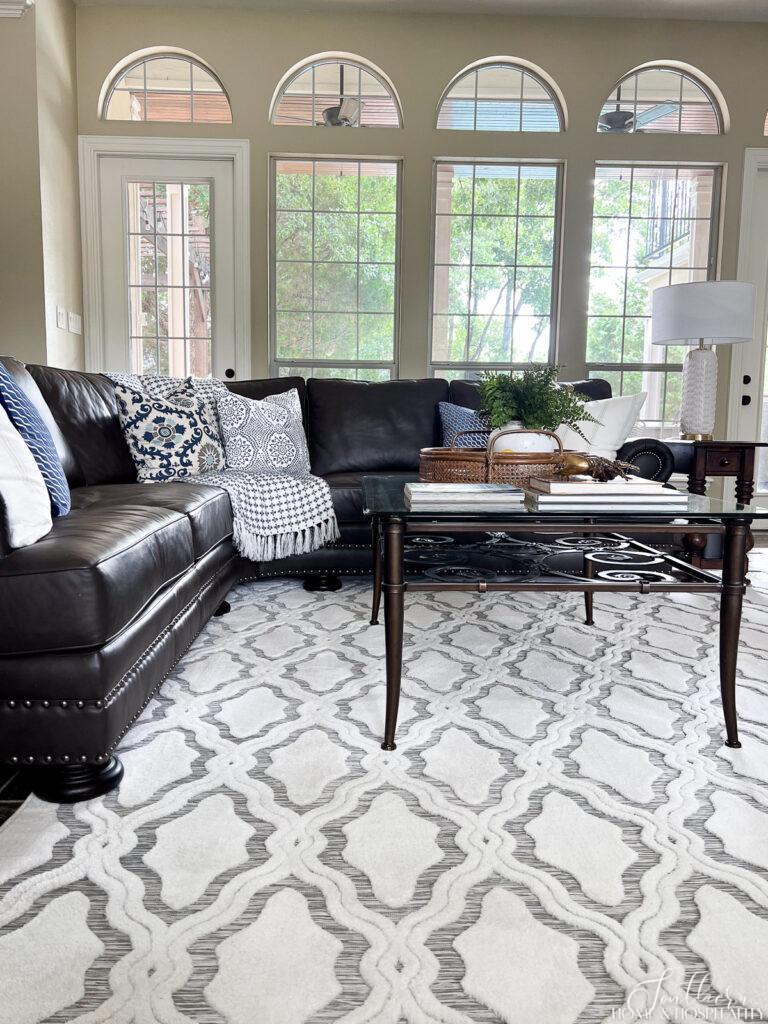
If you’re unsure whether your rug is the right size, I share the simple guidelines I use in my area rug size and placement guide.
3. Everything Is the Same Height or Visual Weight.
This one is sneaky.
If all your decor hits at roughly the same height—similar lamp sizes, similar art scale, similar accessories—the room can feel flat. A little ho-hum. I’ve styled shelves where everything was “pretty,” but nothing stood out. It looked finished… yet it didn’t.
Rooms need contrast. When every piece carries the same visual weight, nothing has impact.
The fix isn’t complicated. Add something taller if everything feels low. Bring in one piece with more presence if everything feels light. Hang art a little larger than feels safe. Or swap out a small lamp for one with a wider base.

4. Your Eye Doesn’t Know Where to Land.
If you walk into a room and don’t immediately know where to look, that’s usually a focal point problem.
It doesn’t have to be dramatic. But something should stand out enough to give the space direction.
Without a clear focal point, whether it’s artwork, a fireplace, a large mirror, or even a strong piece of furniture, everything competes. And when everything competes, the room starts to feel busy even if it isn’t cluttered.
Sometimes the fix is as simple as editing what surrounds your strongest feature so it can stand out. Other times it means making one element slightly larger or more defined so it holds its own.
A room doesn’t need multiple stars. It just needs one clear lead.
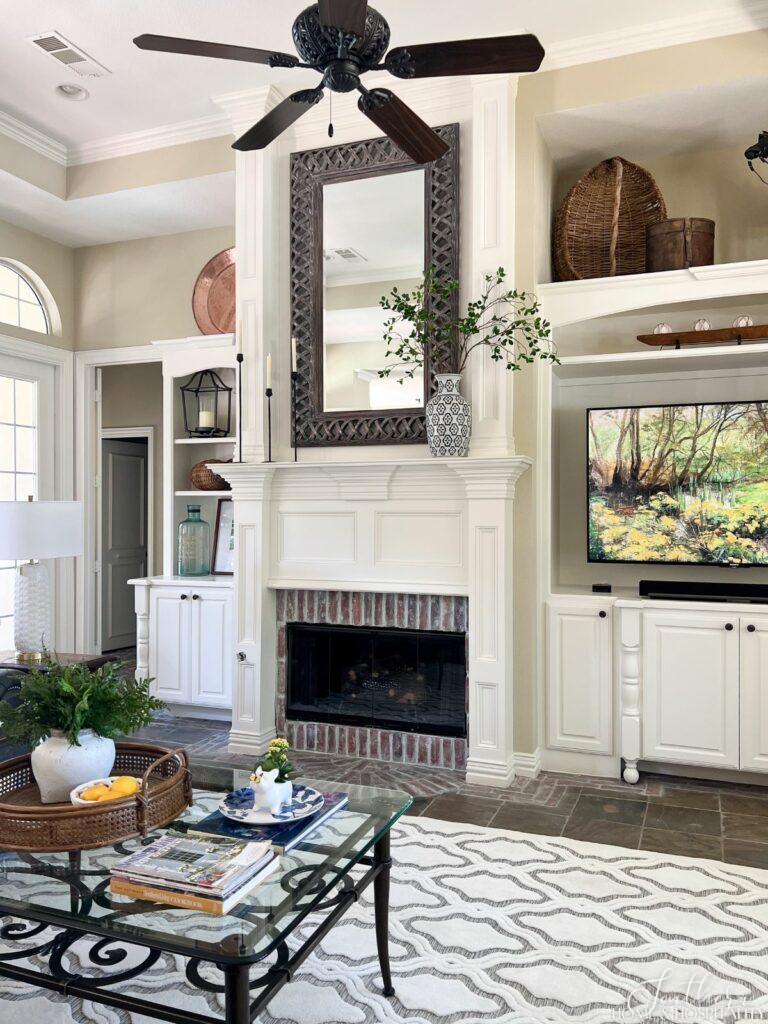
5. The Lighting Is Doing You No Favors.
Lighting can make a perfectly good room feel unfinished.
If the only light source is overhead, everything can start to look one-dimensional and can cast harsh shadows, especially at night. Nothing about the furniture is different, but somehow the whole room feels less inviting.
Lamps aren’t just decorative. They soften edges and create dimension. A table lamp on a side table, a floor lamp near a chair, even a small lamp on a console can change the way the room feels.
In my home, I keep several lamps on timers so they turn on every evening without me thinking about it. That alone makes the room feel more inviting the minute I walk in.
You don’t need more light. You need light at different levels.

6. There’s No Breathing Room.
I’ve absolutely tried to “finish” a room by adding one more thing. Another pillow. Another decorative knick-knack. Maybe one more piece of art. It almost never works.
When every surface is styled and every wall is filled, the room can start to feel crowded. There’s nowhere for your eye to rest, so everything starts competing, and it ends up feeling like clutter.
Sometimes the fastest way to fix a room that feels awkward is to remove something. Clear a few items from the coffee table. Take one thing off the console. Resist the urge to hang something just because the space is empty. Live with it for a few days. You might not want to fill it at all.

7. The Pieces Don’t Connect.
This isn’t about where items are placed in a room. It’s about how it looks together.
You can like every single thing in it and still have the room feel a little all over the place. The sofa might be one style. The art another. The pillows something else entirely. Nothing is wrong, but nothing is talking to anything else.
Often what’s missing is repetition.
If a color shows up once and never again, it feels accidental. If a wood tone appears on one table but nowhere else, it can feel isolated. When materials and shapes don’t echo each other, the room feels disjointed instead of cohesive.
The fix usually isn’t buying something new. It’s repeating what’s already there. Pull a color from the artwork into a pillow. Add a second touch of the same metal finish across the room. Move an accessory so it connects visually with the shape or color of something nearby.
It’s less about matching and more about giving the room a little consistency.

Frequently Asked Questions About Why a Room Feels Off.
Why does my room feel off even though I like everything in it?
Most of the time, it’s not that you chose the wrong pieces. It’s usually something subtle like layout, scale, lighting, or a missing focal point. When one of those is slightly off, the whole room can feel unfinished even if everything in it is nice.
How do I fix a room that feels off without buying anything?
Start by adjusting what you already have. Pull seating closer together, check that your rug is large enough, turn on lamps, and remove a few accessories. Small shifts sometimes make a bigger difference than shopping.
Why does my room not look finished?
Rooms often look unfinished when nothing anchors the space or when there isn’t a clear focal point. Once something grounds the room and gives your eye a place to land, it usually starts to feel complete and polished.
other ways to make your home feel finished
Most rooms that don’t feel right aren’t disasters. They’re just slightly out of alignment. And that’s frustrating because nothing looks obviously wrong—but it’s also good news!
You don’t need to start over. You don’t need different furniture. You might not even need to buy anything. Usually, it’s one small shift: a rug that’s a little too small, a chair that’s a little too far away, a room that’s trying to call your attention to too many things at once.
Once you spot it, it’s usually a simple fix. And when you sit down and stop mentally rearranging the space, that’s when you know you got it right.

Before you go:
As always, I appreciate your visit, comments, and shares here on the blog! I’d love it if you also follow along with me on Pinterest, Instagram, Facebook, TikTok, and YouTube so you won’t miss any of my inspiration and ideas.
Don’t forget to sign up for updates to keep in touch.
If you’re not already a member of the SH&H family, I’d love to have you join me! You’ll not only get email updates, but you’ll have exclusive access to all the bonus materials in my free subscriber-only library, like this:
Pin it to remember it!
If you’ve enjoyed this post, please pin and share this on Pinterest:
