

How to Style Throw Pillows on a Sofa (How Many, What Size, and How to Arrange Them)

Inside: Learn how to style throw pillows on a sofa, including how many pillows to use, the best pillow sizes, insert sizing, and simple arrangement ideas that look “right”.

This post contains Amazon and other affiliate links for your convenience. As an Amazon Associate I earn from qualifying purchases. If you purchase something through any link, I may receive a small commission, at no extra charge to you. I only recommend products that I love or would purchase for myself. See my full disclosure here.
If you looked at my sofa right now, you might think I’ve always had this throw pillow situation figured out.
I haven’t.
I’ve bought an embarrassing number of throw pillows in my lifetime. Okay—mostly because they’re an easy way to instantly change color scheme, style, season, and even camouflage a sofa you don’t love.
But I’ve bought (and donated) soooo many more that just didn’t work once I got them home.
Once I finally figured out a few simple things about throw pillows, my sofas started to look not only a lot more pulled together, but a lot more comfortable too.
It really comes down to a few small things—how many you use, what size to choose, and how you layer them so a sofa feels inviting instead of too bare—or like it’s there just for display.
How to Arrange Throw Pillows on a Sofa (A Simple Layering Method).
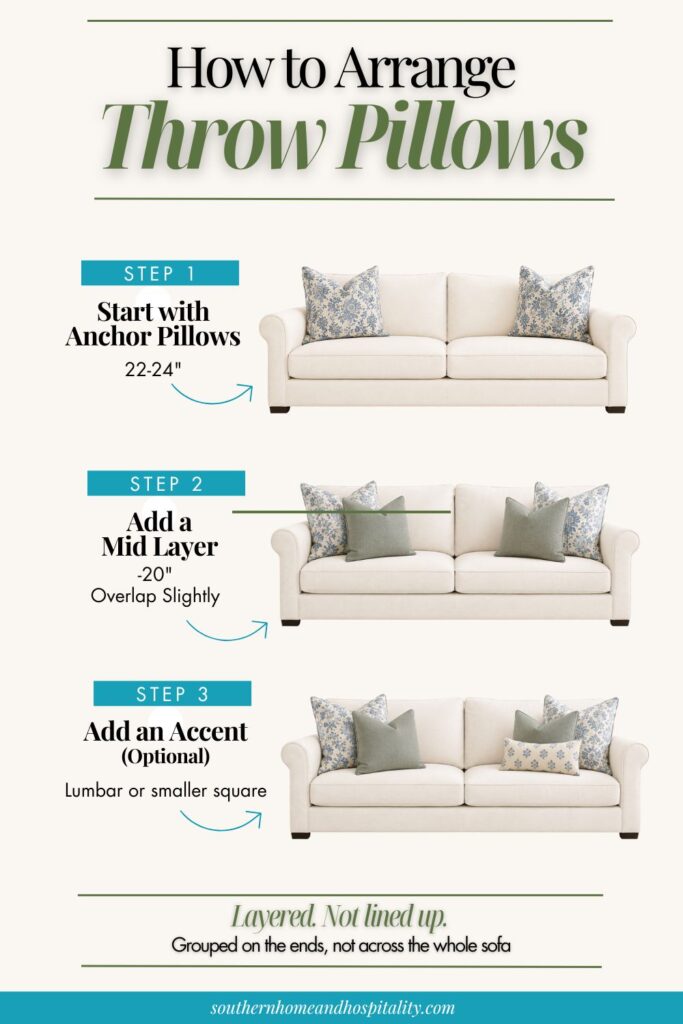
Arranging throw pillows is much simpler once you think of them in layers.

Start with Anchor Pillows to Frame the Sofa.

Begin with your largest pillows on each end. These are what give the arrangement a foundational frame.
On most sofas, that’s going to be something in the 22–24 inch range, and they sit right in the back corners.
This step tends to make everything else easier, because now you have a clear starting point. Without it, smaller pillows can end up looking like they’re just scattered around instead of part of a plan.
Add a Mid Layer for Depth.

Next, bring in a slightly smaller pillow and place it just in front of the larger one.
Usually that’s something in the 20-inch range, and it should sit slightly overlapping the back pillow—not lined up beside it. When all the pillows are the same size, or spaced evenly across the sofa, it tends to look stiff and a little awkward.
That small shift in size, along with the overlap, is what makes the arrangement feel comfortable and inviting.
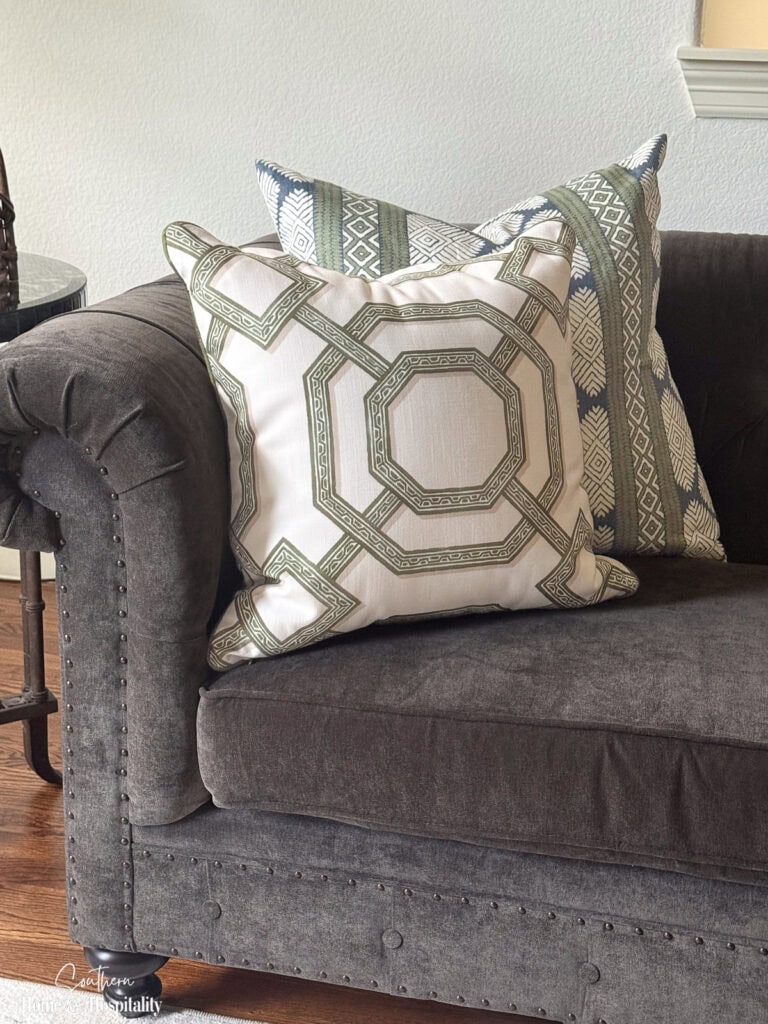
A small variation that can make this more livable: On deeper sofas with tall enough arms (like mine below), you don’t always have to place that second pillow toward the inside. Sometimes I’ll layer it on the outside instead. It still gives that layered look, but leaves more room to actually sit.
Finish with an Accent Pillow (Optional).
This last layer is optional, but it’s where you can add a little personality and interest if you want it.
This is usually a smaller pillow, either a lumbar (around 12×20 or 14×24) or a smaller square (around 18″). It should sit slightly in front of and overlapping the pillows behind it on one end or both sides of the sofa.
They don’t need to match, and they don’t need to be repeated. In fact, using just one or mixing them slightly is usually what makes the whole arrangement feel more relaxed.
How to Keep Your Throw Pillow Arrangement Balanced.
Once your pillows are in place, the last step is just stepping back and looking at the sofa as a whole.
A Simple Symmetrical Setup.
If you like things to feel more clean and calm, match the same setup on both ends of the sofa. Same sizes, same placement. It’s the easiest option, and it always looks polished.
A More Relaxed, Asymmetrical Look.
If you prefer something less structured and more casual, you don’t have to match everything exactly, but it still needs to feel balanced.

Instead of repeating the exact same pillows on both sides, think about visual weight.
That usually comes down to how bold the colors and patterns feel. If one side has a stronger pattern or deeper color, the other side should stay in that same general range so it doesn’t feel like one side is louder than the other.
You can still vary what you use. One side might have two pillows layered together, while the other has a single larger one. Or you might mix patterns on one side and keep the other a little simpler, but still within the same color palette and intensity.
The goal isn’t to make both sides match. It’s to make them feel equally balanced when you step back and look at the whole sofa. If your eye keeps going to one side first, that’s usually a sign something needs to be adjusted.
Leave a Little Space.
This is the part that makes the biggest difference in usability.
You don’t need to fill the entire sofa with pillows, as if it’s purpose is to be a pillow holder. A sofa is for sitting. Leave a little open space to make it functional

How to Mix Color, Pattern, and Texture.
This is usually the part that either makes pillows look layered and interesting… or like a little too much is going on.
In my home, I’ve found it’s less about finding the “perfect” set and more about keeping a few simple things in mind so everything works together.
Start With a Simple Color Direction.
Before worrying about patterns, it helps to decide what colors you’re working with.
That doesn’t mean everything has to match or that every pillow has to have the same color in it, but they should feel connected. I usually pull from other decor already in the room and build from there. This tends to keep things from feeling random, which can lead to the pillows looking “wrong“.

Mix Patterns in Different Scales (Not All the Same).
If you want to use patterns, it helps to vary the size of them.
A larger pattern paired with a smaller, more subtle one tends to feel balanced. When everything is bold or everything is tiny, it can either feel overwhelming or a little “meh“.
You don’t need a lot—just two patterns can do the job.
Use Texture to Add Interest.
This is the easiest way to make pillows feel layered and coordinated without going wrong.
Mixing different fabric textures like linen, velvet, or a subtle woven texture adds interest without solely relying on colors or patterns.
Make Sure One Element Ties Everything Together.
Even when you’re mixing things up, it helps to have something consistent—whether that’s a shared color, a similar tone, or a repeated texture. Without that, pillows can feel like they don’t “go” with each other as a polished set.
How to Style Throw Pillows on Different Types of Sofas.
Not every sofa needs the same setup, and this is where a lot of confusion comes in.
Standard Sofas (The Easiest Place to Start).
This is where the layering method works exactly as we’ve already covered. It’s the most forgiving setup, and usually the easiest to get right.
You’ve got enough space for:
- anchor pillows
- a mid layer
- and accents if you want them
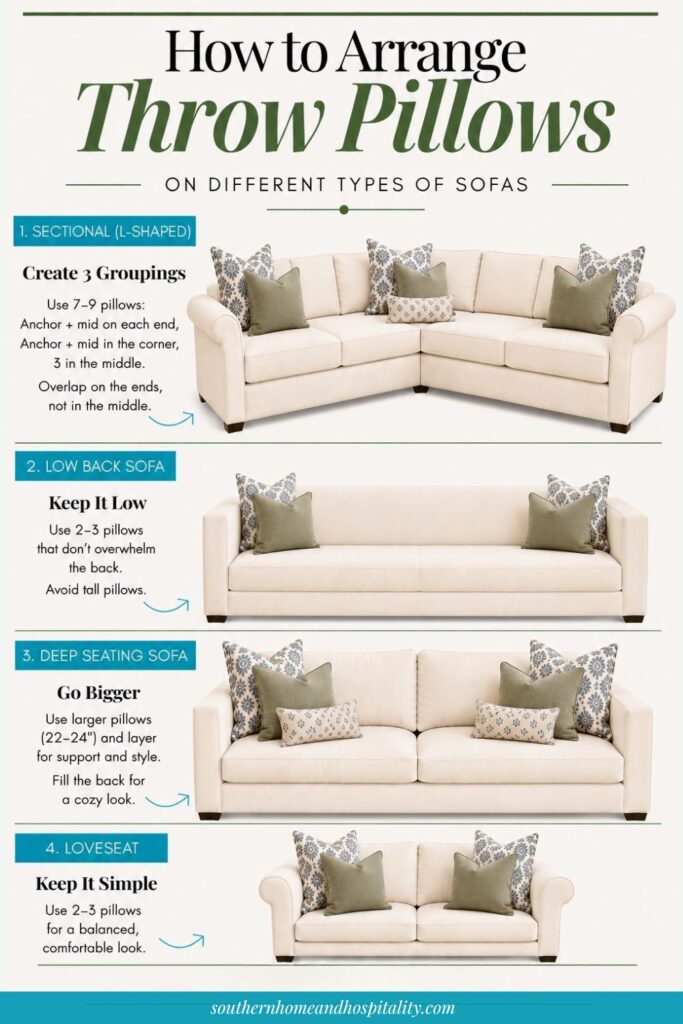
Sectionals (Focus on the Ends and the Corner).
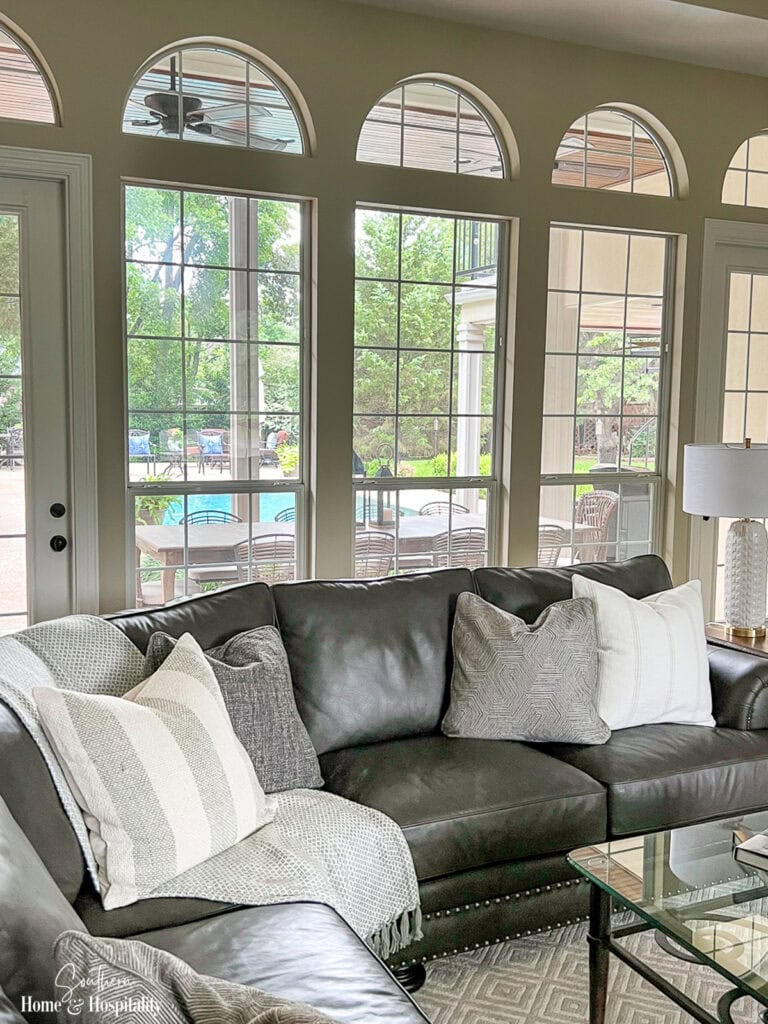
Only place pillows in three zones: the two ends and the corner.
Start the same way you would on a regular sofa by adding your anchor pillows and a mid layer to each end. Then repeat that in the corner where the sectional meets.
The corner can carry more visual weight because it’s the natural focal point of the sectional. So if I’m adding an accent pillow, that’s the first place it goes. On the ends, I usually stop at the mid layer or keep any accent pillows minimal. It’s easy to overdo it here because sectionals can have so much more room.
While it’s easy to repeat the exact same pillows in the corner, sometimes the third isn’t a charm. Changing up at least the mid-layer pillow just a bit keeps it from feeling too matched and predictable.
Loveseats (Why Less is More).
On a loveseat, less really does work better. I usually stick with two anchor pillows on the ends and add one accent pillow for a little interest. It gives you that layered look without making the whole thing feel full of pillows and unusable.
Deep Seating Sofas (Why Bigger Pillows Matter More Here).
Deep sofas can handle larger pillows, and they usually need them.
Standard pillows can look puny, so this is where going up to a 24-inch really makes a difference. Because there’s more space to fill, a few well-sized pillows usually look better than trying to layer several smaller ones.
Low-Back Sofas (What to Avoid So They Don’t Look Overwhelmed).
Pay attention to size and adjust accordingly for low profile sofas. If you want a clean, more minimal look, pay attention to height, and don’t over-pillow.
How to Choose the Right Size Throw Pillows for Your Sofa.
This is one of the biggest reasons pillows don’t look quite right, even when you’ve nailed color, texture, and placement.
The Best Pillow Sizes for Most Sofas.
For most standard sofas:
- 22-inch pillows work best as your anchor
- 20-inch pillows work well layered in front
How Sofa Depth and Height Affect Pillow Size.
It’s really about proportion more than rules for exact sizes. The deeper and taller your sofa, the more it can handle (and needs) larger pillows. Shallower or more tailored sofas usually look better with slightly smaller ones so they don’t feel out of proportion and take the appropriate amount of room.
Why 18-Inch Pillows Often Look Too Small.
This is one I’ve run into many times. Eighteen-inch pillows are easy to find, but on most sofas, they just don’t have enough presence. They can work as an accent, but on their own, they tend to look a little underwhelming.
What Size Pillow Insert to Use (And Why It Matters).
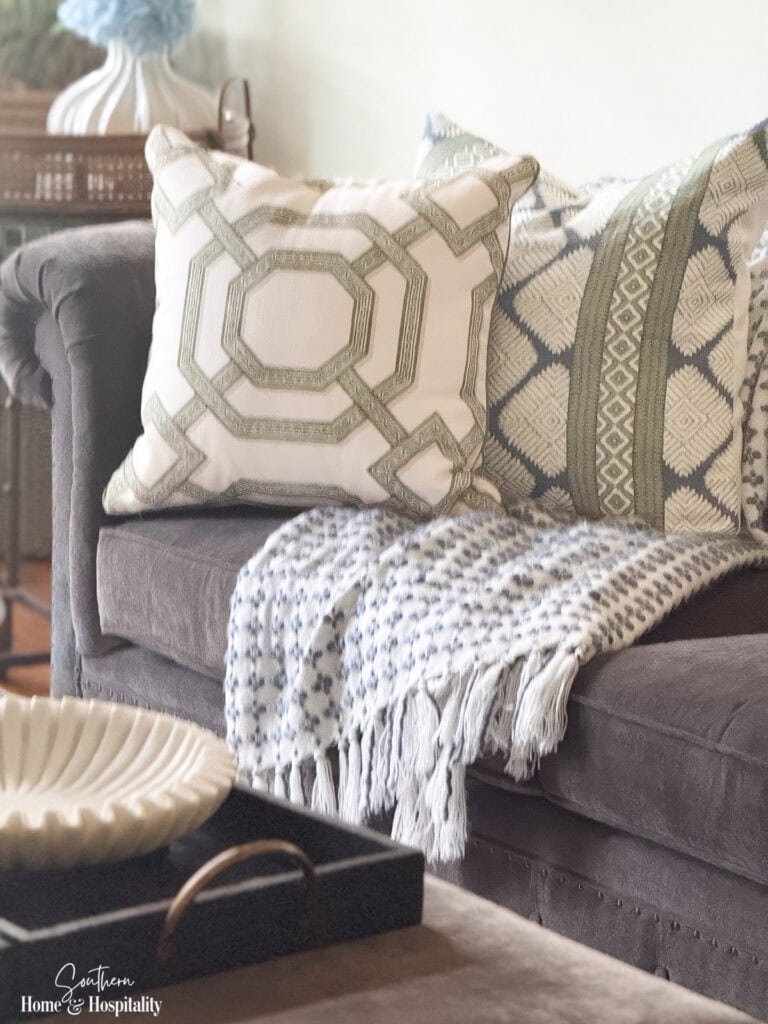
This is one of those small details that makes a big difference in how expensive (or cheap) your throw pillows look.
Always Size Up 1–2 Inches.
If your cover is 20 inches, use a 22-inch insert.
If it’s 22 inches, use a 24-inch insert.
That extra fill is what gives pillows that full, designer look.
Down vs. Down Alternative (What to Know).
Both work, but they behave differently.
Down inserts:
- softer and more relaxed
- easier to shape and fluff
- give that slightly “lived-in” look
Down alternative:
- more structured and holds its shape
- less maintenance (doesn’t need as much fluffing)
- usually more budget-friendly
If you like a softer, more casual look, down tends to work better.
If you prefer something that stays neat and structured, down alternative is easier to live with.
Why Some Pillows Always Look Flat.
Most of the time, it’s because the insert is the same size or smaller than the cover. That’s what leads to a sad-looking pillow about as welcoming as nestling into a pancake.
Should You Karate Chop Throw Pillows or Not?
There are definitely two camps. Some feel like the karate chop looks a little dated or too styled at this point, while others still like the softer, shaped look it gives a pillow. Like most of this, it really just comes down to what looks right to you.
Even if it is considered by some to be soooo 2006, personally I still like the karate chop. Not in a super sharp, overdone way, but just enough to break up that stiff square shape. It makes the pillow look a little more relaxed and a little less straight out of the packaging.
For the karate chop finish, softer inserts especially down, tend to work better and look more natural. With more structured pillow filling, it can look a little forced.
A Simple Throw Pillow Cheat Sheet (Quick Reference).

If you’re standing in front of your standard sofa and just want a quick plan, here’s what works:
- Start with 2–4 pillows for most sofas
- Use 22″ anchor pillows on the ends
- Add one slightly smaller pillow (around 20″) inside, overlapping the anchors
- Optional: 1 accent pillow layered inside one or both of the secondary pillows
- Use inserts 1–2 inches larger than the cover
more Decorating Posts You Might Like
- Area Rug Size and Placement Guide: Easy Rules for Every Room (+Printable)
- The Easy Way to Hang a Gallery Wall
- Why Your Room Doesn’t Feel Quite Right (And What’s Probably Causing It)
- Where Do I Put the Furniture in a Room? Basics for Placing and Spacing
- How to Decorate a Long Dining Table (and Get the Scale Right)
Even though I’ve finally learned all of this, I’m not going to pretend I’ve stopped buying throw pillows.
That’s probably not happening.
Maybe not everyone gets excited about bringing home a pretty pillow like me, but something as small and unassuming as a simple throw pillow can give me that little taste of joy that redecorating a whole room brings—usually for less than $50.
But at least now I know what works—and I don’t end up donating half of them a few months later.

Before you go:
As always, I appreciate your visit, comments, and shares here on the blog! I’d love it if you also follow along with me on Pinterest, Instagram, Facebook, TikTok, and YouTube so you won’t miss any of my inspiration and ideas.
Don’t forget to sign up for updates to keep in touch.
If you’re not already a member of the SH&H family, I’d love to have you join me! You’ll not only get email updates, but you’ll have exclusive access to all the bonus materials in my free subscriber-only library, like this:
Great ideas, however with so many pillows leaves little room for people/company. Pillows get tossed on the floor. Maybe that’s why they’re called throw pillows! 😆 lol…