

The Easy Way to Hang a Gallery Wall

Inside: Learn how to hang a gallery wall the easy way using paper templates, a tape measure, and a level so you can get perfectly spaced picture frames without making a lot of extra nail holes!
This post contains Amazon and other affiliate links for your convenience. As an Amazon Associate I earn from qualifying purchases. If you purchase something through any link, I may receive a small commission, at no extra charge to you. I only recommend products that I love or would purchase for myself. See my full disclosure here.
If you’ve been following me over the past year, you know I downsized to a villa from a fairly large house. While I love how manageable and cozy it is, one of the challenges that came with less space was figuring out how to display family photos in a way that didn’t feel cluttered. I knew I didn’t want to cover every surface or wall with random frames, but I also wanted my home to reflect the people and memories that make it mine.
So I came up with two solutions.
First, I added a digital photo frame on my entryway table that scrolls through hundreds of pictures from years past and everyday moments—it’s been the perfect way to keep all those memories close without using up physical space.

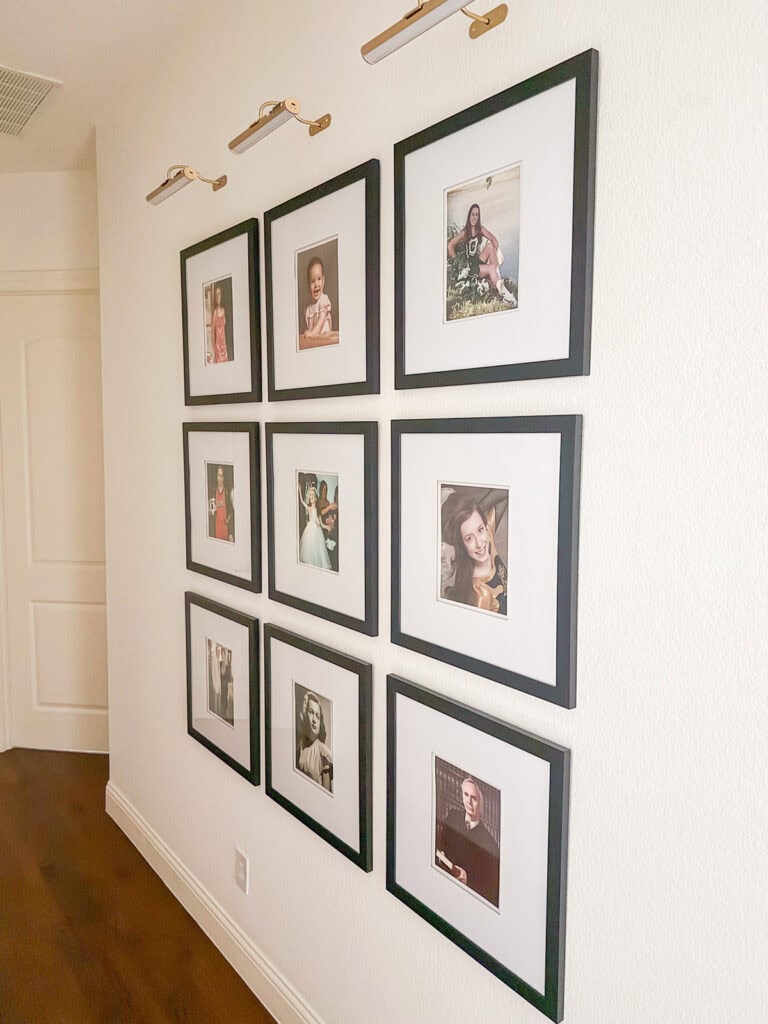
And second, I chose a more curated approach for the walls. In my long, dark hallway that felt more like a blank tunnel than a part of the home, I hung a symmetrical gallery wall of nine black picture frames with family photos in a neat grid pattern. It turned that “neglected-for-a-whole-year” stretch into something meaningful, personal, and beautifully pulled together—without overwhelming the small space.


If you’re looking for a clean, classic way to display photos or pieces of art that makes a statement without visual clutter, a symmetrical gallery wall might just be the perfect solution. Plus, it’s a great way to make a big impact on a blank wall. Here’s exactly how I hung mine—without frustration, and without leaving a bunch of nail holes in the wall.
The Best Way to Hang a Symmetrical Gallery Wall.
Whether you’re hanging family photos, artwork, or a mix of both, using templates is one of the easiest ways to create a gallery wall without guesswork. This method works for large walls, hallways, staircases, and even smaller gallery wall arrangements where precise spacing matters.
This method is perfect if you’re using matching frame sizes and want that crisp, symmetrical gallery wall layout. My large frames were all the same size, with white mats and black frames for a high-contrast look that really popped in the dim hallway.
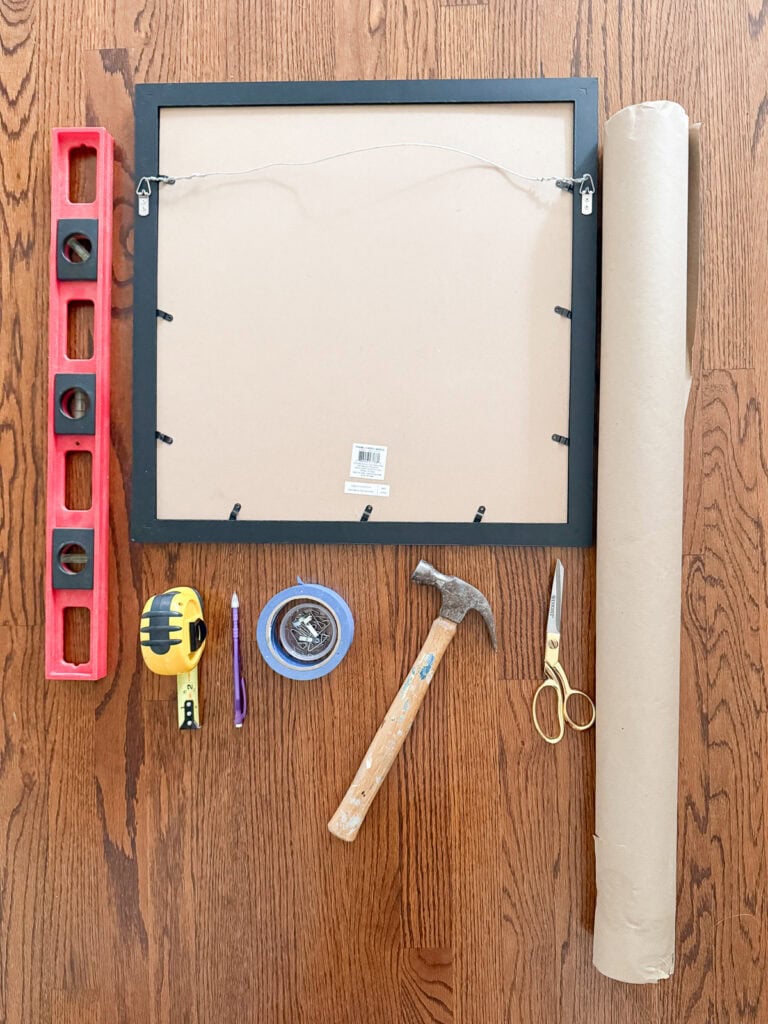
Supplies:
- Measuring tape
- Wrapping paper or kraft paper (for paper templates)
- Painter’s tape (for marking and taping templates)
- Scissors
- Pencil
- Hammer
- Picture hangers
- Picture wire (optional—I attached the wire to eye hooks on the back of the frames)
- Level
- Command Strips
- Step stool or ladder
My Step-by-Step Process:
1. Laying out the gallery plan.
The first thing I did was lay all of the frames with the photos inside out on the floor to decide what order and position I wanted them in (the placement matters if you use picture wire or have different sized frames.)
2. Adding the picture wire.
My frames had two eye hooks on each side. Because I am terrible at getting two nails exactly level, I added picture wire to them which would give me some grace in leveling the frame after it was hung. (If the back of your frame has single hanging hardware you can skip this step.)
3. Making templates to avoid mistakes.


Next, I traced each frame onto kraft paper and cut out nine paper templates.
4. Marking the templates.


I measured from the top of each frame to where the picture wire naturally pulls when taut. I marked this spot on each template, and then measured the space from the bottom of the picture hanger to where the nail would thread through it. Then I made a second mark which would be where the nail should go.
I labeled every single template according to what frame I had marked it for, because the picture wire would hang at a slightly different distance on each—I simply labeled mine by the photo, but you could also label it according to its position in the gallery.
5. Marking the center of the gallery.
I measured the hallway wall width to find the center point. Then I measured the right height so that the middle row would fall at eye level—around 58 inches from the floor to the center of the middle frame (the standard decorating rule is 57″-60″). I made a mark on the wall where the two intersected.
If you’d like to know more about how to hang pictures at the right height, see the post “How High to Hang Pictures and Artwork (with Printable Guide)“
6. Hanging the templates on the wall.

I taped the templates to the wall using painter’s tape, starting with the center one. I measured and marked the center of this template and made a small hole so I could see the center mark on the wall to position it over, and used a level to make it straight. After the center template was hung, I worked my way out, using the level and a measuring tape to make sure the spacing was even—2.5 inches between frames worked perfectly for my wall.
This step is so worth it—you can step back and tweak the spacing, adjust the height, and make sure the whole grid feels balanced before you ever pick up a hammer!
7. Installing the hangers.

Once everything looked just right, I hammered the picture hangers into the wall right through each template where I had marked them. Then I carefully pulled the templates off the wall, leaving just the nails behind.
8. Hanging and leveling the frames.
I hung each frame by the wire on the picture hanger—then I checked them with the level, and adjusted them as needed.

To keep them from shifting (especially in a narrow hallway where they could get bumped), I added Command strips to the bottom corners of each frame. After I was satisfied with the look of the gallery, I removed each frame individually, added the Command strips and rehung, re-leveled, and then firmly pressed the frame into the wall until the strips were well adhered.

Gallery Wall Lighting.

Because my hallway has no natural light, I added small picture lights above the top row of frames. They’re battery-operated and motion-sensor, so they turn on automatically when I walk down the hall! It really elevated the gallery and makes me remember to notice the photos.
Hanging a Non-Symmetrical Gallery Wall.
Whether symmetrical or not, a good gallery wall adds personality. It fills up empty wall space, and turns it into something special.
An eclectic mix of frames and artwork—maybe some larger pieces, a few smaller pieces, or a mix of family photos and vintage finds, works beautifully in a living room, dining room, or above a piece of furniture where you want a more collected and creative feel. The layout will be a little different, but the method is the same.
Here’s what I recommend:
- Lay everything out on the floor first to find a balance.
- Start with your anchor piece—the largest or most eye-catching piece of art—and build around it.
- Keep consistent spacing between all of the frames (2–3 inches is a good rule of thumb).
FAQ’s About Hanging a Gallery Wall at a Glance:
What is the easiest way to hang a gallery wall?
Using paper templates allows you to test spacing and placement before making nail holes in the wall.
How much space should be between gallery wall frames?
For most gallery walls, 2–3 inches between frames creates a balanced look. I used 2.5 inches for this hallway gallery wall.
How high should a gallery wall be hung?
A common decorating guideline is to place the center of the arrangement approximately 57–60 inches from the floor.

This easy project transformed this highly used but boring, dark hallway from the garage entry to the main living area into a place that I actually enjoy walking through all the time!
Hanging gallery walls doesn’t have to be hard—or leave your walls looking like Swiss cheese. With a little planning, some paper templates, and a roll of painter’s tape, you can create the perfect gallery wall for your space and hang it with confidence.

Before you go:
As always, I appreciate your visit, comments, and shares here on the blog! I’d love it if you also follow along with me on Pinterest, Instagram, Facebook, TikTok, and YouTube so you won’t miss any of my inspiration and ideas.
Don’t forget to sign up for updates to keep in touch.
If you’re not already a member of the SH&H family, I’d love to have you join me! You’ll not only get email updates, but you’ll have exclusive access to all the bonus materials in my free subscriber-only library, like this:
Pin it to remember it!
If you’ve enjoyed this post, please pin and share this on Pinterest:

where did you get the battery motion picture wall lights?. thank you.
Hi Karen! I got them off of Amazon. Here is the link to the exact light: https://amzn.to/4dZaDOn