

How to Choose Kitchen Hardware and Where to Place It (The Complete Guide)

Inside: Everything you need to know about choosing kitchen cabinet knobs and pulls—from styles and finishes to exact placement rules. This guide breaks it all down with diagrams and examples so you can update your cabinets with confidence.

This post contains Amazon and other affiliate links for your convenience. As an Amazon Associate I earn from qualifying purchases. If you purchase something through any link, I may receive a small commission, at no extra charge to you. I only recommend products that I love or would purchase for myself. See my full disclosure here.
Hardware really is the jewelry of the kitchen. Just like the final finishing touch to an outfit, the right knobs and pulls can really bring perfect polish to this entire space.
But if you’ve ever stood in front of a wall of options, you know it can feel overwhelming. Should you choose knobs or pulls? What size? What finish? And once you’ve decided, where exactly do you put them?
When I moved into my downsized villa, the cabinets had no hardware, and it drove me absolutely bonkers. I can’t tell you how many times I pulled on the wrong side of a door or broke a nail trying to pry open a drawer. I finally remedied that and had to figure out the answers to these same questions along the way.
So I pulled together all of my experience and research into this post—your complete cabinet hardware handbook. Below you’ll find simple rules, diagrams, and answers to the most common questions about style, function, placement, and scale.
Why Kitchen Cabinet Hardware Matters.
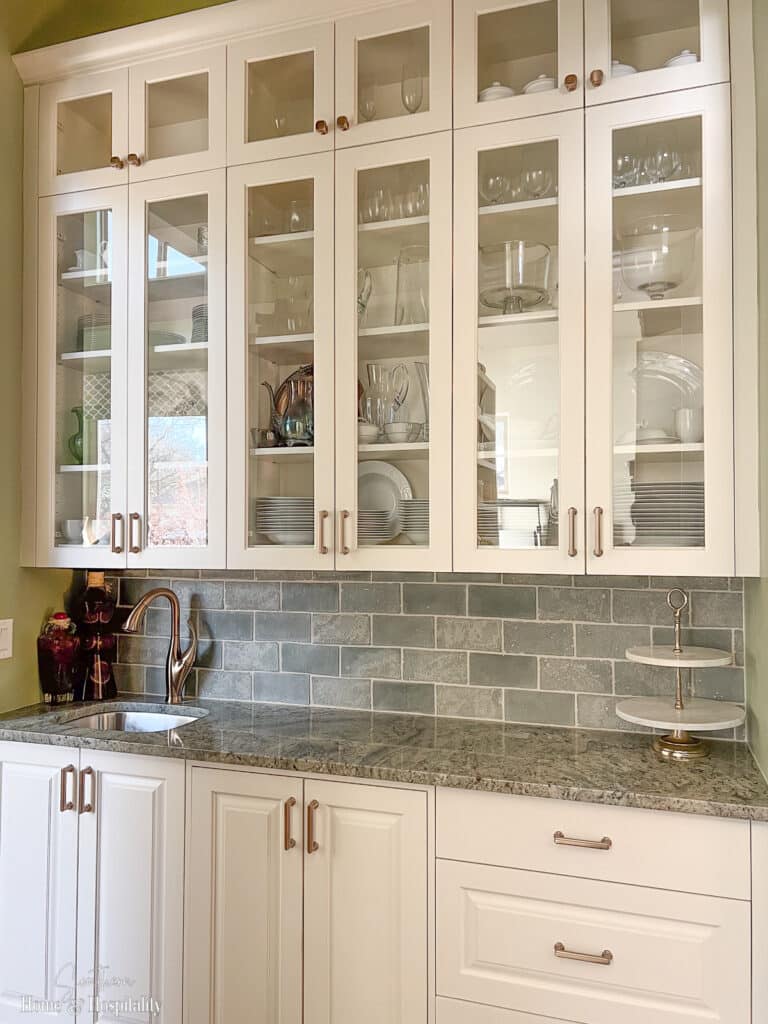
It’s such a small detail, but hardware does a lot of heavy lifting!
- Function. Knobs and pulls make it easier to open cabinets and drawers (and keep your finish from smudges and wear).
- Style. They instantly update your kitchen without a remodel—it’s the quickest facelift your cabinets can get.
- Budget-friendly. Compared to other improvements, hardware is an inexpensive way to upgrade the look of your entire kitchen.
How to Choose Kitchen Hardware.
Choosing Hardware Style.
Your cabinet style often points you in the right direction:
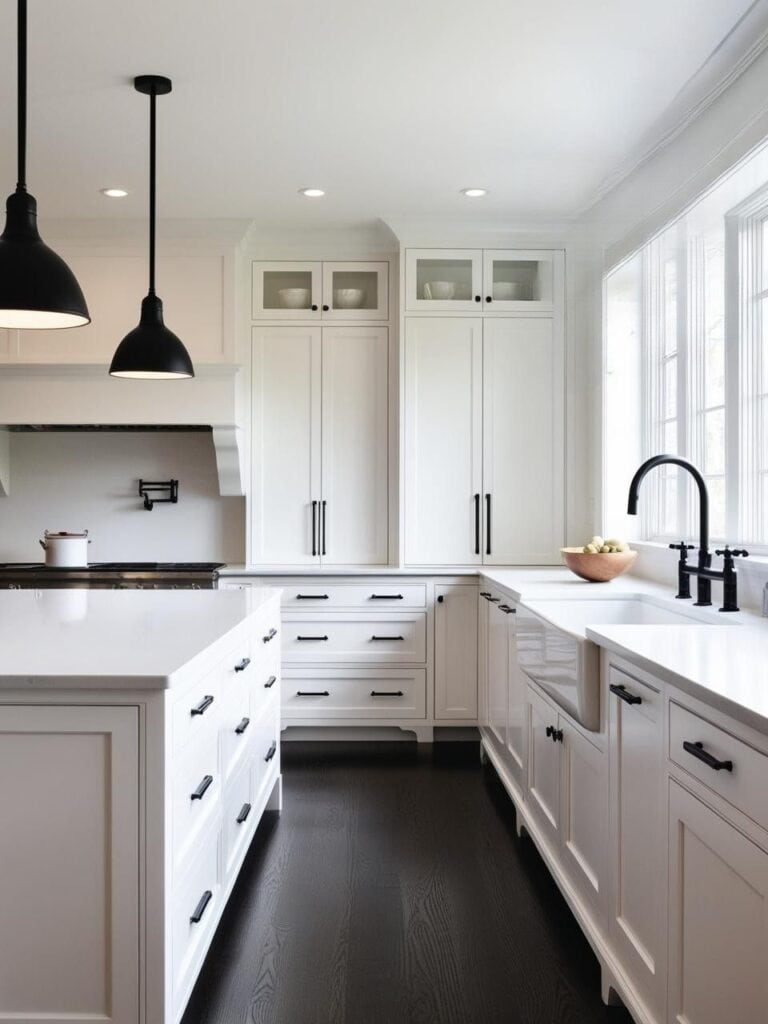
- Shaker or flat-front cabinets: clean-lined pulls, simple knobs.
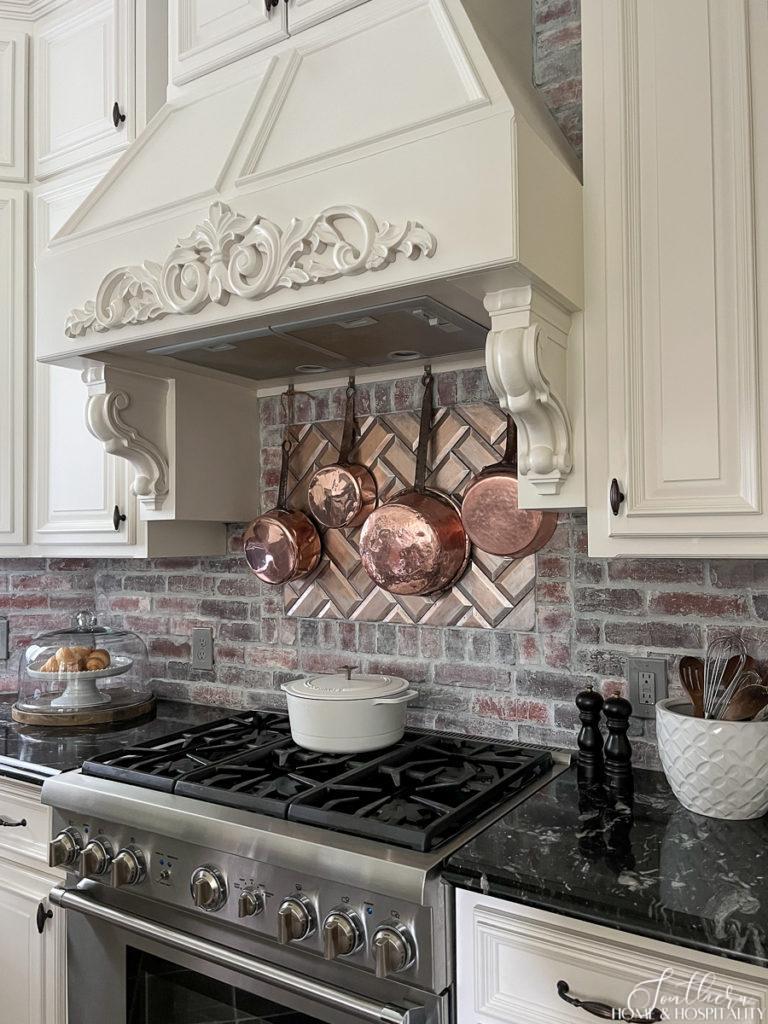
- Raised-panel or traditional cabinets: classic round knobs, bin pulls, and hardware with a little more decorative detail
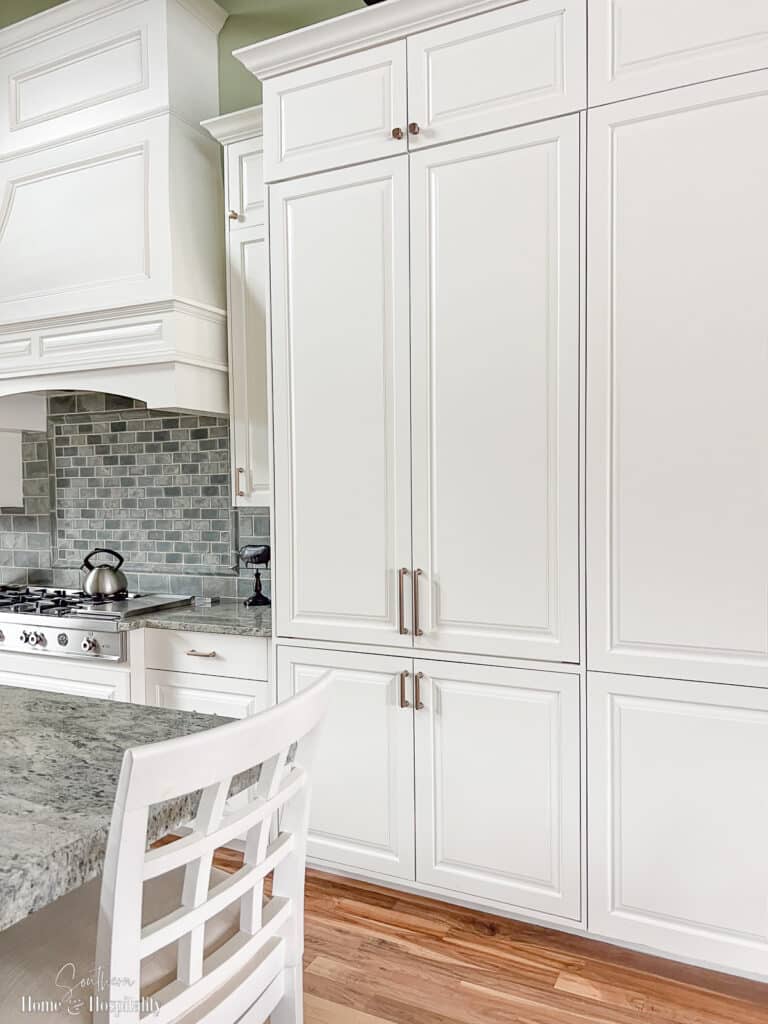
- Transitional kitchens: hardware that bridges the gap between traditional and modern—think simple shapes (like straight pulls) paired with warmer finishes or a touch of detail so they’re not too stark.
Choosing Hardware Finish.
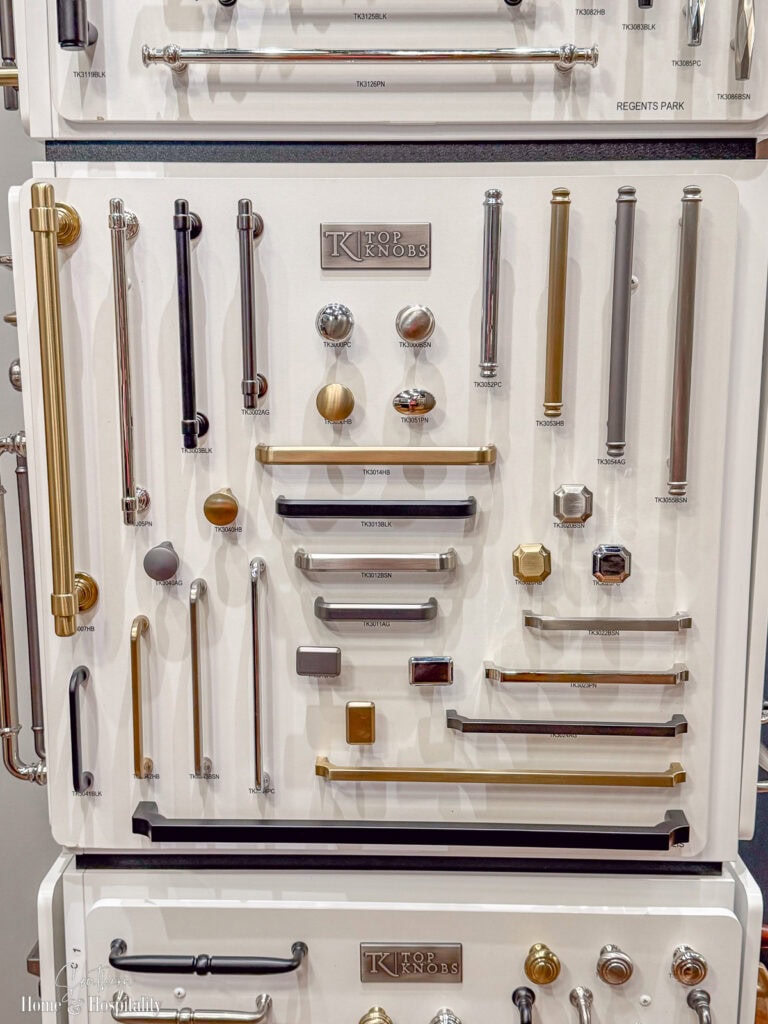
Hardware finish can blend in or make a bold statement.
- Keep it consistent with other kitchen fixtures, or mix on purpose. Match to your faucet or lighting, or choose a complementary contrast.
- Popular finishes: Brushed nickel, matte black, gold or brass, and chrome. Matte black feels modern and dramatic, polished chrome is crisp and classic, and warm brass adds instant warmth and character.
- Contrast tip: Dark hardware pops on white cabinets while blending in more on darker cabinets; brass or nickel stand out on dark colors like navy or stained wood, and are more understated on white.

Choosing Knobs vs. Pulls.

- Knobs are classic, smaller, and typically round. They work well on doors and are budget-friendly.
- Pulls are longer handles, often used on drawers, and easier to grip to open larger and heavier cabinets. They can add a streamlined, more modern look. Using all pulls for both doors and drawers is a big trend right now.
- Mixing both is the most classic choice—knobs for doors, pulls for drawers.
- But here’s the truth: knobs versus pulls is really a matter of personal preference! My style leans more traditional, so I gravitate toward knobs on doors and pulls on drawers. But sometimes I mix it up—I recently used pulls on most of my upper cabinet doors.
SH&H Tip: Use knobs for lighter doors and smaller drawers, and pulls for larger or heavier drawers and tall pantry doors. Pulls give you more leverage, which makes them more functional when you’re dealing with weight.
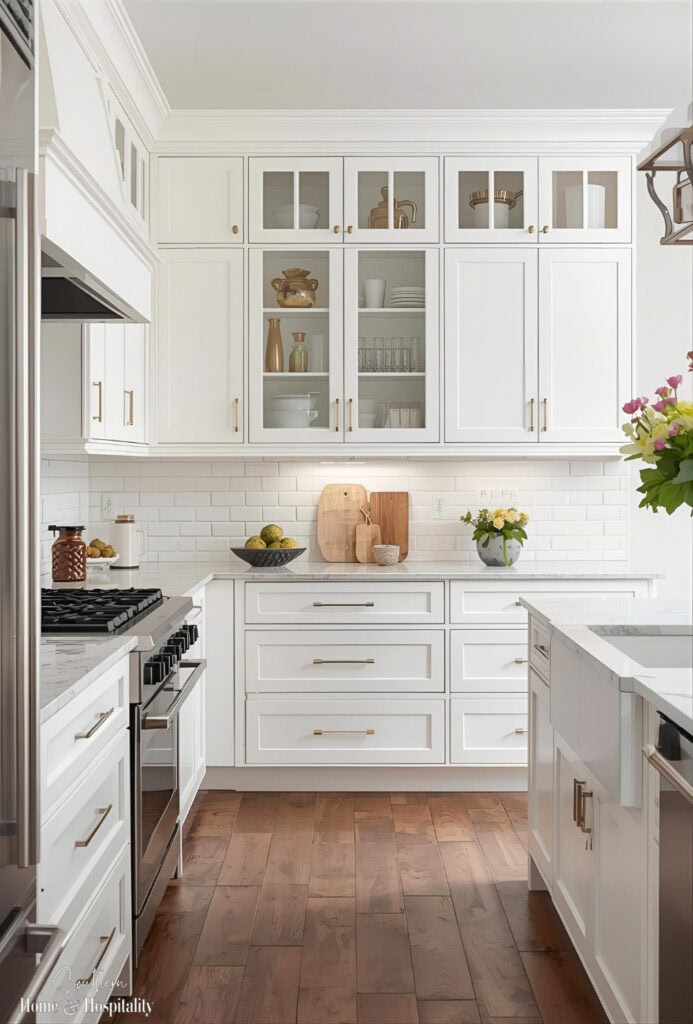
The bigger key, even more than a steadfast rule about what goes where, is choosing a knob or a pull that is the right scale and has the right placement.
Choosing Scale and Proportion.
Getting the size right is so important. Hardware that’s too small or too large can be distracting and throw off the proportions of the whole kitchen.

What size pulls for kitchen drawers?
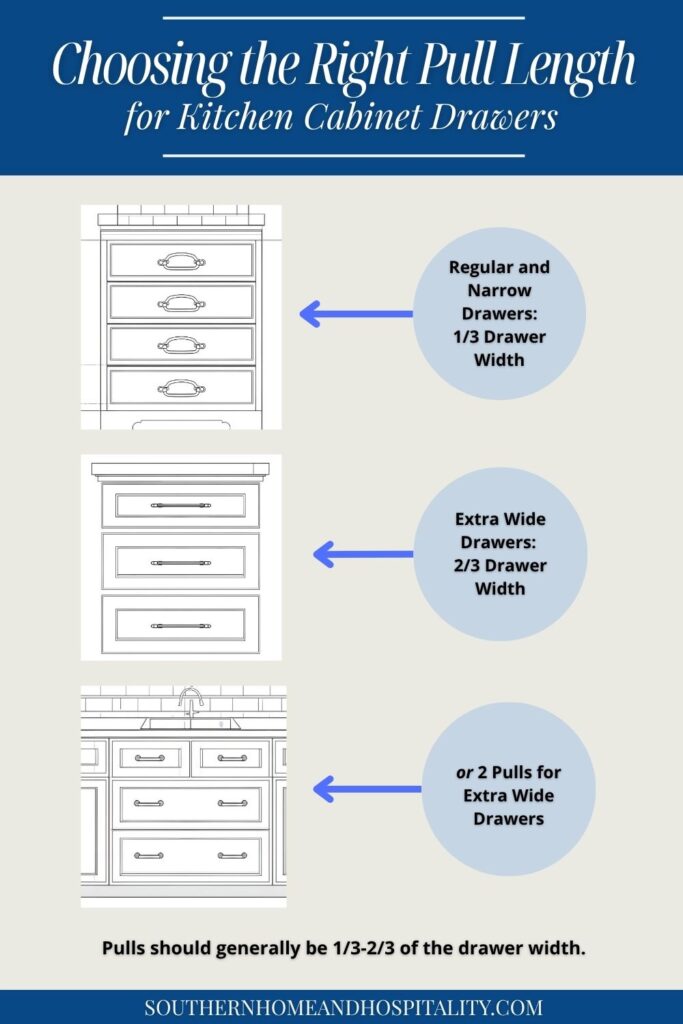
- A good rule of thumb is that the pull should be about one-third the width of the drawer front.
- For wider drawers (30 inches or more), go up to two-thirds the width, or use two pulls spaced evenly.
What size pulls for cabinet doors?
- Standard cabinet doors look balanced with pulls in the 5-6 inch range.
- Tall doors like pantry doors often need longer pulls (8–12 inches) for both looks and functionality.
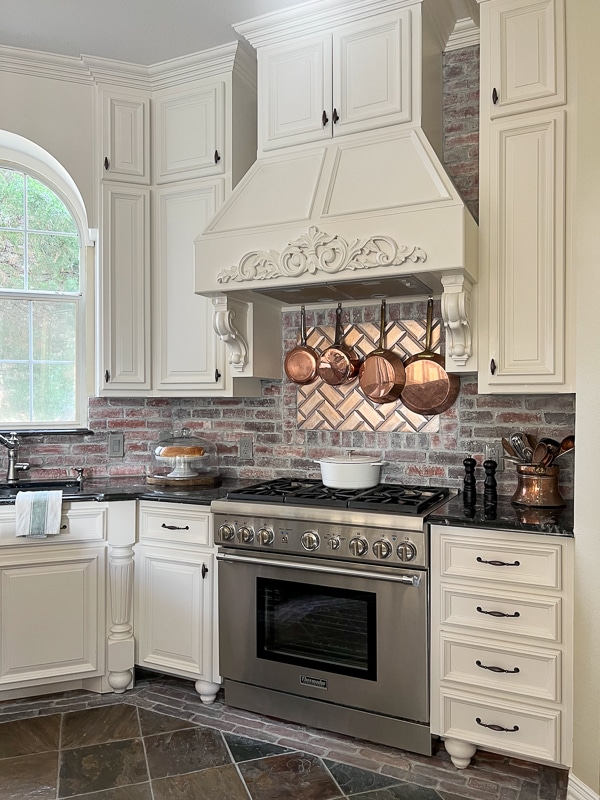
In my own kitchen, I actually used 9-inch pulls on my upper cabinet doors. They’re a little longer than the typical range, but I loved the look and they still feel proportional:

Knob size guide.
- Standard knobs range from 1 1/8 to 1 1/4 inches, which works for most cabinet doors.
- On large cabinets or tall pantry doors, scale up to 1 1/2 inches for better proportion.
SH&H Tip: Guidelines like these are a starting point. If you prefer either a bolder or more understated look, size up or down—the most important thing is that the hardware looks proportional and functions well for your space.
Where to Place Kitchen Hardware.
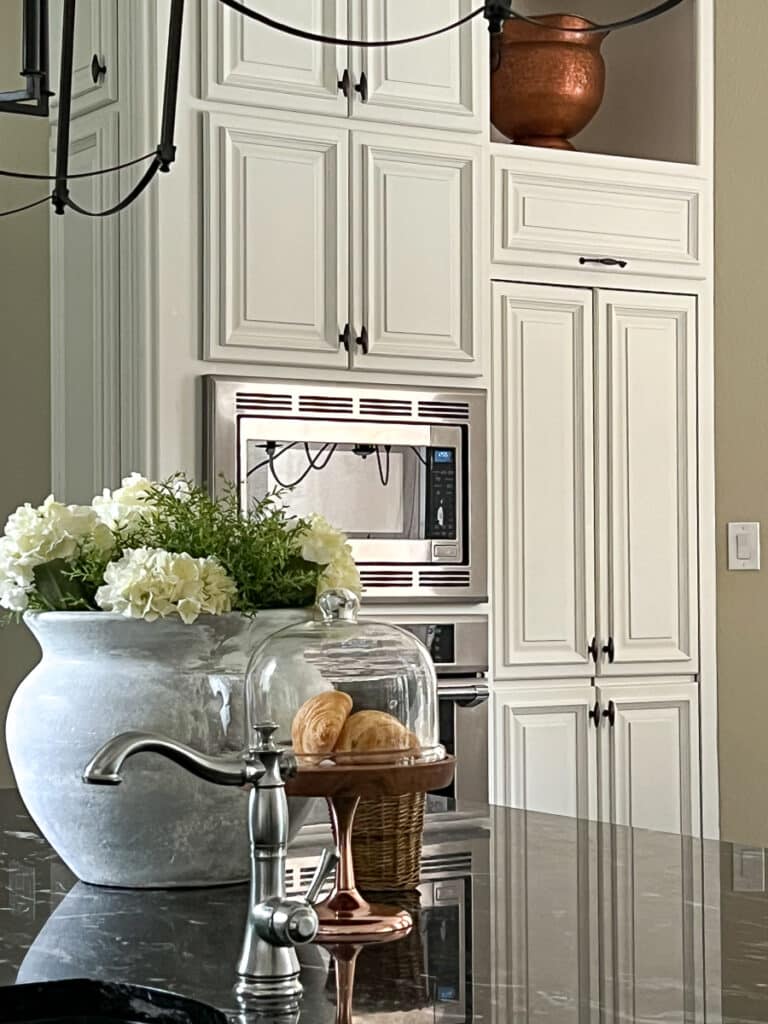
Here’s the part that makes most people nervous—holes in those expensive cabinets seem so permanent. But once you know the rules, it’s not so scary.
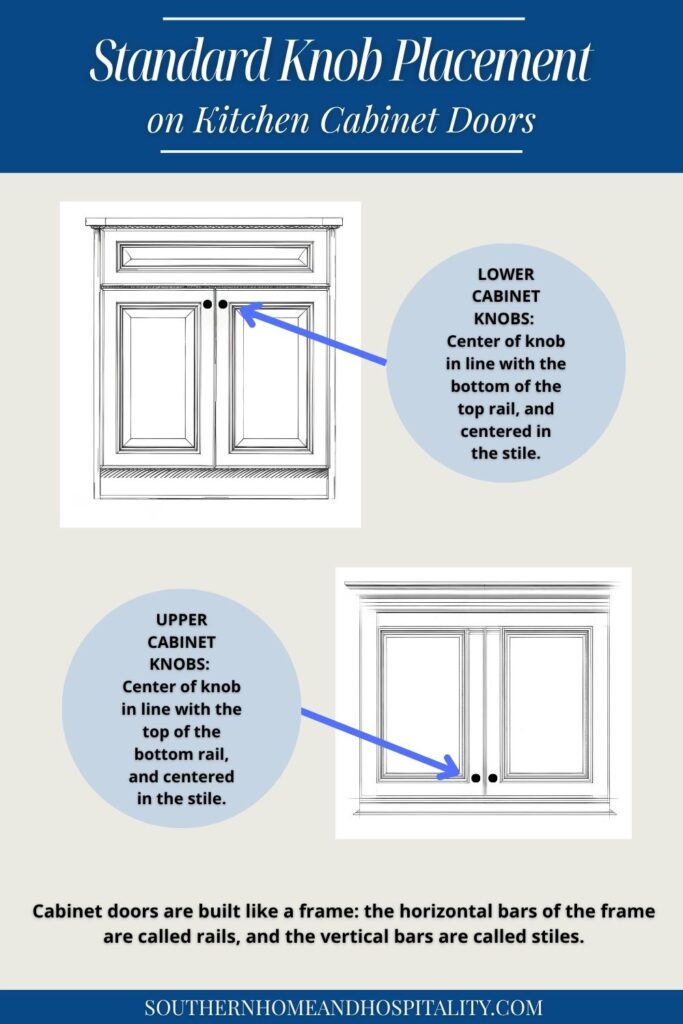
Cabinet doors with frames are built with two vertical side pieces, called stiles, and two horizontal top and bottom pieces, called rails. I prefer to use these frame lines as my guide for where hardware should go because it keeps everything nicely lined up and visually balanced. For some reason, I find it so much less awkward looking than having hardware slightly lower or higher. (The fact that this messes with me makes me question whether I have OCD).
Knob Placement on Cabinet Doors.

- Upper cabinets: Place the knob so its center lines up with the top of the bottom rail (the horizontal bar), and is centered in the stile (the vertical frame piece).
- Lower cabinets: Place the knob so its center lines up with the bottom of the top rail (the horizontal bar), and is centered in the stile (the vertical frame piece).
- Flat, modern doors: If your cabinets don’t have rails and stiles (completely flat fronts), mimic the same placement by measuring 2–3 inches in from the top or bottom corner.
Pull Placement on Cabinet Doors.

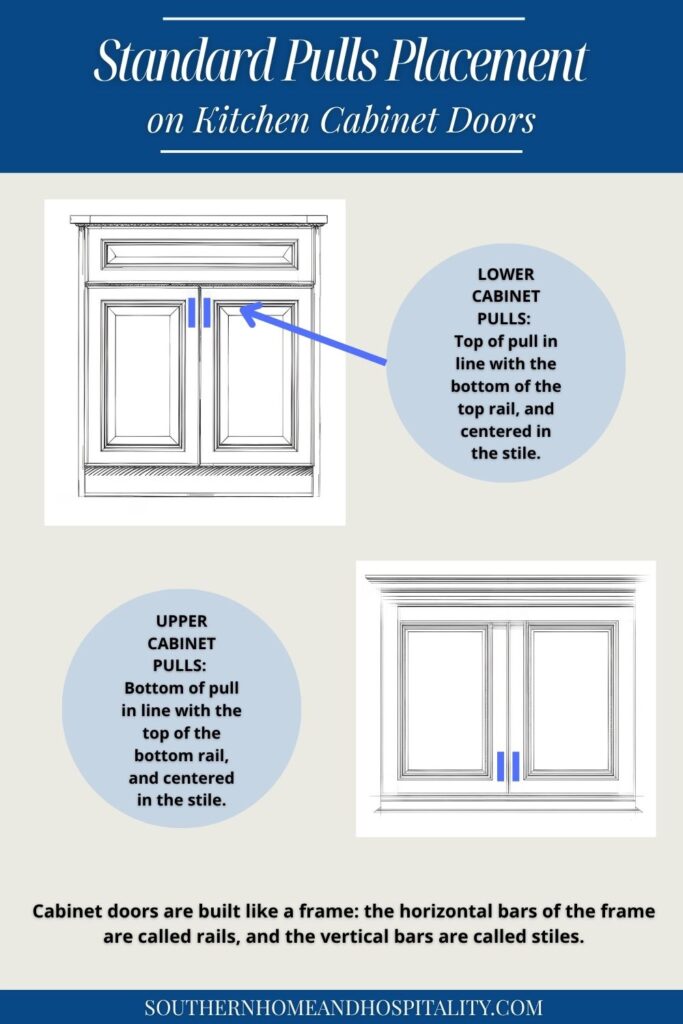
Pulls follow the same logic as knobs—the most balanced look comes from lining them up with the cabinet’s frame pieces.
- Upper cabinets (vertical pulls): Place the pull so the bottom of the pull lines up with the top of the bottom rail (the horizontal frame piece), and is centered in the stile (the vertical frame piece).
- Lower cabinets (vertical pulls): Place the pull so the top of the pull lines up with the bottom of the top rail (the horizontal frame piece), and is centered in the stile (the vertical frame piece).
- Horizontal pulls: Or for a modern look, place the pull horizontally along the bottom rail of upper cabinets, and the top rail for lowers.
- Flat, modern doors: With no stiles or rails to guide you, use the corner measurement method: place vertical pulls 2–3 inches in from the door corner. For horizontal pulls, mount them centered about 2–3 inches up from the bottom edge on upper cabinets or 2–3 inches down from the top edge on lower cabinets.
Pull Placement on Drawers.
Small and medium drawers: Use one pull, centered. For medium drawers, a pull that’s about one-third of the drawer width usually looks most proportional.
Wider drawers:
- Use one long pull that’s about two-thirds the width of the drawer, or
- Use two pulls evenly spaced. To place two pulls, measure the drawer width, divide it into thirds, and center each pull on the left and right third.
Specialty Pulls Placement: Appliances, Trash, and Tall Cabinets.
Appliance pulls.
Many cabinet panel-ready appliances require oversized pulls for both functionality and aesthetics. The extra length provides better leverage for heavy doors and keeps proportions visually balanced. Search specifically for “appliance pulls” when shopping for appliance hardware.

- Refrigerator pulls: Place the pull at a comfortable height for leverage when opening the heavy door—usually around chest height.
- Dishwasher pulls: Since most dishwasher custom cabinet panels have a “frame” like cabinet doors, center the pull on the top horizontal frame piece, or rail.
SH&H Tip: Always match the finish of appliance pulls to your cabinetry hardware for a cohesive look.
Trash pull-outs.
Trash pull-outs should be treated like deep drawers, but with one key difference: always mount the pull centered on the top rail.
Tall pantry doors.
Extra-tall doors look best with a long vertical pull. For balance, you can center the pulls vertically over the horizontal rails so it feels visually anchored as long as it’s at a natural height for function and everyday use—about where your hand would comfortably reach to open the door.
Tips for Installing Cabinet Hardware.
The hardest part about hardware isn’t choosing it—it’s committing to drilling that first hole! A few simple tools and tricks can make the process so much less stressful:
- Use a template. An inexpensive plastic or metal hardware template takes the guesswork out of drilling and keeps placement perfectly consistent from door to door and drawer to drawer. Lowes has the Liberty AlignRight Template, but there are also options on Amazon if you prefer to order online.
- Mark before you drill. Always measure twice and mark the exact placement with a pencil or painter’s tape.
- Drill a pilot hole. Start with a small drill bit before moving up to the full screw size—this keeps the wood from splitting.
- Double-check alignment. Stand back and look at the first knob or pull in place before finishing the rest. It’s easier to correct one hole than ten.
SH&H Tip:
To avoid problems when drilling:
- Apply painter’s tape over the spot before drilling to help stabilize the wood grain, then drill a small pilot hole before using the full-size bit.
- For a cleaner hole on the back side, hold a piece of scrap wood (a “drilling block”) tightly against the inside of the door to prevent splintering as the bit exits.
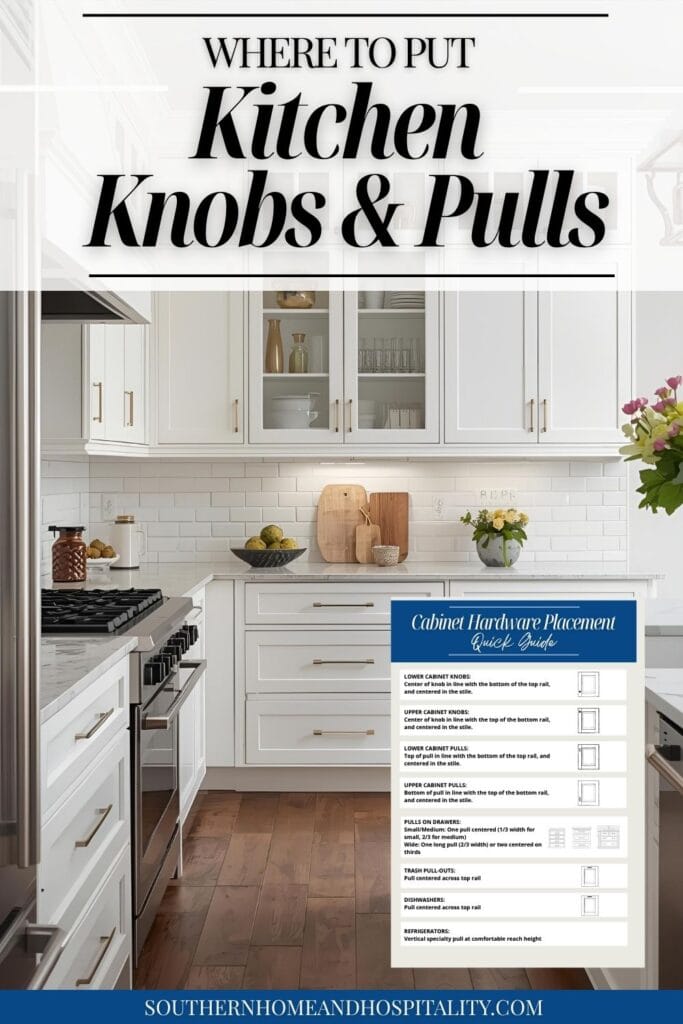
Cabinet Hardware Placement Quick Guide.
Here’s a summary of the placement rules to keep handy:

- Knobs on Doors:
- Upper cabinets: Centered on the stile, in line with the top of the bottom rail.
- Lower cabinets: Centered on the stile, in line with the bottom of the top rail.
- Vertical Pulls on Doors:
- Upper cabinets: Bottom of pull aligns with the top of the bottom rail.
- Lower cabinets: Top of pull aligns with the bottom of the top rail.
- Horizontal Pulls on Doors:
- Upper cabinets: About 2–3 inches up from the bottom edge.
- Lower cabinets: About 2–3 inches down from the top edge.
- Pulls on Drawers:
- Small and medium drawers: One pull, centered (about one-third of drawer width).
- Wide drawers: One long pull (about two-thirds width) or two pulls, centered on the left and right thirds.
- Trash Pull-outs: One pull, centered on the top rail for strength and function.
- Dishwashers: Appliance pull centered across the top rail or stile for easy use.
- Refrigerators: Appliance pull placed at a comfortable reach height for leverage, usually around chest height.
- Tall Pantry Doors: Long vertical pull, centered on the stile and over a horizontal rail at a natural grab height.
FAQs About Kitchen Cabinet Hardware:
When should I use backplates?
Backplates add style, cover old holes, and protect cabinet surfaces from wear. They work with both knobs and pulls for an additional luxury kitchen touch.

When should I choose hardware during the design process?
Keep hardware in mind when designing cabinets, but order once the cabinetry is installed so you can confirm scale and proportion.
What if the new hardware holes don’t line up with the old ones?
If you’re replacing hardware and the holes don’t match up, you have a few options. The easiest is to choose new hardware with the same hole spacing as your old pulls (measure the “center-to-center” distance between the screw holes). If that’s not possible, you can fill the old holes with wood filler and touch up or repaint the cabinet finish before drilling new ones. Another trick is to use backplates, which cover the old holes while giving the hardware a decorative base.
Should you mix finishes for cabinet hardware?
I don’t usually recommend mixing finishes on cabinetry hardware—it’s tricky to pull off. If you want to mix metals, it’s easier to do that in other areas of the room—like lighting, faucets, or accents, where the contrast feels intentional. If you do decide to mix, it works best with clearly different finishes (like black with brass). Avoid combining two versions of the same metal, such as polished and brushed nickel, which often looks like a mistake instead of a design choice.
The Smallest Details Can Make a Big Difference.
Cabinet hardware might feel like a small choice, but it’s amazing how many decisions go into it, and how big a difference it makes once it’s installed. If you’ve been putting off this upgrade because you’re worried about making a mistake, I hope these guidelines and diagrams help remove that roadblock for you.
And take it from my experience… once those knobs and pulls are in place, you’ll be so much happier with everyday living in your kitchen!
This post is part of my series on decorating an outdated kitchen, where I’m sharing the small, budget-friendly changes I’ve made to bring my early 2000s kitchen up to date without a major remodel. From working with orange-toned cabinets and brown granite to updating fixtures and finishes, I’m breaking down each dated feature one step at a time. More in the series:
- How to Update a Kitchen with Brown Granite and Outdated Features (No Big Budget Needed!)
- How to Tone Down Orange Cabinets with a Black Paint Wash
- How to Whitewash a Tiled Backsplash
- How to Style Kitchen Counters without Adding Clutter
- The Best Paint Colors for Kitchens with Brown Granite
- How to Decorate Above Kitchen Cabinets Without Looking Cluttered or Dated

Before you go:
As always, I appreciate your visit, comments, and shares here on the blog! I’d love it if you also follow along with me on Pinterest, Instagram, Facebook, TikTok, and YouTube so you won’t miss any of my inspiration and ideas.
Don’t forget to sign up for updates to keep in touch.
If you’re not already a member of the SH&H family, I’d love to have you join me! You’ll not only get email updates, but you’ll have exclusive access to all the bonus materials in my free subscriber-only library, like this:
Pin it to remember it!
If you’ve enjoyed this post, please pin and share this on Pinterest:
I was wondering where you could buy the pulls on the blue cabinets
I took that photo at a local appliance and fixture showroom, but unfortunately I don’t know what brand they were. Sorry!
Hello, I’m on a search for handles for a kitchen renovation, and wondering where you found the long drawer pulls in the 8th picture…on the first natural wood color cabinets. They’re exactly what I’m hoping to find.
I believe you’re talking about the pulls from my kitchen so I actually do know where they’re from…Amazon! For these extra long ones I needed bronze which they didn’t offer in that size, so I bought black and spray painted them to match the others. Here’s the link: https://amzn.to/3Yz41PT
I really appreciate comprehensive articles like this that offer practical guides on how to properly undertake a major install or renovation. Thank you so much as always for sharing your invaluable expertise with us.